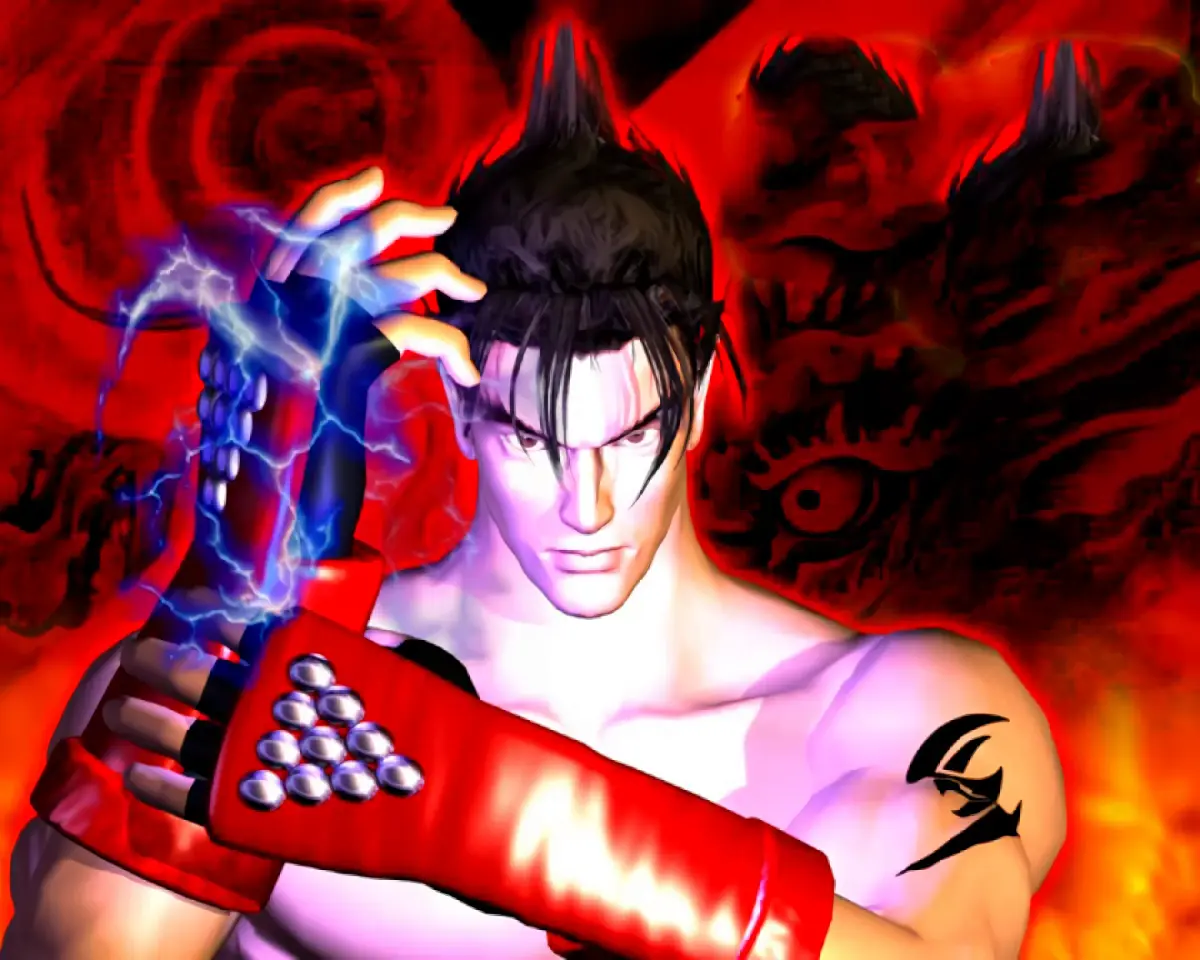
Tekken 3 on PlayStation is a legendary 3D fighting game where you master Jin Kazama and a roster of iconic characters. You'll be pulling off devastating combos and learning intricate move sets to conquer the King of Iron Fist Tournament. It's a deep, rewarding experience perfect for anyone looking to test their fighting skills.
This guide dives deep into Tekken 3, helping you master essential controls and providing strategies for early stages of Arcade Mode. We'll also uncover secrets like unlocking alternate costumes, exploring the challenging Tekken Force mode, and finding all the hidden content in the gallery. Get ready to conquer the tournament and unlock everything the game has to offer.
Part 1
Tekken 3 move list and guide for ARC version, updated 12/12/1998 by Barry Wright Moretz. Includes disclaimer and legal implications.
- 1The guide was created by Tekken 3 players for Tekken 3 players.
- 2No part of this document may be reproduced and sold for profit.
- 3The information is intended for recreational use only and may only be redistributed in its entirety by electronic or printed format, or with the expressed written consent of Barry Wright Moretz.
- 4The only modification allowed is to cut the condensed KEY at the very bottom and paste it into a new text document for referencing notations.
- 5If reading in printed format, you may 'cut along the dotted line' to achieve the same effect.
- 6By continuing to read, you accept that any beat-downs, ass-stompings, glitches with your computer, or other problems encountered are purely your fault.
- 7The newest version of the FAQ may be found at the URL provided in the original source.
- 8Factual information, such as how to perform a move, cannot be copyrighted.
- 9The format of the facts presented and arguable items like strategy are protected by copyright laws.
- You may contact the author via email at dncbmw@hotmail.com.
- The author notes major contributors to the FAQ, including Andy Tatman, Brett 'playa' Bataglia, Dan 'PPhoenix' Benedict, and many others listed alphabetically.
- The move list is intended for recreational use.
Part 2
Dive into Tekken 3 Part 2! Learn essential controls, move notations, and character stances to dominate the arena. Your guide to mastering Tekken 3.
Alright, so you've gotten the hang of the basics and maybe even tried out a few characters. Now, let's really dig into what makes Tekken 3 tick. This section is all about getting you comfortable with the nitty-gritty: how to move, how to read the move lists, and understanding those tricky stances.
Optimal Viewing Settings:
First off, let's make sure you're seeing the game and this guide the way it's intended. The author recommends using a text editor like MS WordPad that displays text in a 'mono-space' format. This means every character takes up the same amount of horizontal space, which helps align things perfectly. If the row of periods under 'OPTIMAL VIEWING SETTINGS' lines up with the numbers below it, you're good to go. They also suggest using a 640x480 display resolution. If you're on Windows 95/98, you can change this by right-clicking your desktop, going to 'Properties', then the 'Settings' tab, and adjusting the 'Desktop area' slider. You'll need to restart your computer for the changes to take effect. This setup ensures you see all the details without awkward spacing.
What's New / FAQ History:
This guide has been updated over time. Version 0.60 was the first release, revamping the FAQ structure into General and Specific sections, adding movelists, and switching from the 'lp, rp, lk, rk' notation to the numeric '1, 2, 3, 4' standard. Later updates, like version 0.65, completed character movelists (like Jin Kazama), added details on delayable special throws, corrected input errors for normal throws, and improved uniformity across sections.
Contents Overview:
This FAQ is broken down to make things easy:
- Title: The main title of the guide.
- Disclaimer: Legal and ethical stuff.
- What's New: A summary of updates.
- Contents: What you're looking at right now.
- Introduction: A general intro to the game.
- Key: This is super important! It explains all the abbreviations and terms used throughout the FAQ.
- Interface: How the controller and buttons work.
- Term Notations: Explains movement, positioning, different attack types (normal, counter, juggle), and special stances.
- Special Stances: Details on unique stances for characters like Eddy Gordo, Gun-Jack, Hwoarang, Kuma, Lei Wulong, Ling Xiaoyu, and Yoshimitsu.
- Important Terms: General game terms and concepts.
- Outlines: How character info and difficult moves are organized.
Key - Understanding the Notation:
This is crucial for reading move lists. Forget 'lp' (left punch) and 'lk' (left kick) for now; this guide uses numbers:
- 1 = Left Punch (LP)
- 2 = Right Punch (RP)
- 3 = Left Kick (LK)
- 4 = Right Kick (RK)
You'll also see notations for movement and positioning:
- Movement: Forward, Back, Up, Down (relative to your character's facing direction).
- Positioning: Where you are on the screen matters!
- Attack Types: Normal Attacks, Counterattacks, and Juggle Attacks (combos).
- Special Stances: Some characters have unique stances that change their available moves. These are detailed for Eddy Gordo, Gun-Jack, Hwoarang, Kuma, Lei Wulong, Ling Xiaoyu, and Yoshimitsu.
General Section - Controlling Your Character:
This part covers the fundamentals:
- Basic Movement: How to maneuver around the stage, attack your opponent, and cancel out of moves.
- Techable Throws: If you get grabbed, you might be able to 'tech' out of it to avoid damage.
- Difficult Moves: These are the more complex inputs that often lead to powerful attacks or combos.
Mastering these controls and understanding the notation is your next big step. It might seem like a lot, but once it clicks, you'll be pulling off moves you never thought possible!
Part 3
Dive into Part 3 of our Tekken 3 guide. Learn advanced strategies, timing moves, and master defending against tricky attacks to dominate your opponents.
Alright, welcome to Part 3! This section is where we really start to dig into the nitty-gritty of Tekken 3. Forget just button-mashing; we're talking about truly understanding the game's mechanics and how to outsmart your opponents. This guide is packed with insights that have seriously improved my own game, and I'm sure they'll help you climb the ranks too.
We'll cover everything from the finer points of move timing – like strings, reversals, and sidesteps – to specific technical aspects such as damage modifiers and even some of the game's quirks. The core of this section, though, is about strategy: how to attack effectively, when to defend, and how to counter common tactics like 'poking' and 'turtling'. We'll also get into the specifics of how to handle every character on the roster, from Bryan Fury to Yoshimitsu.
Think of this as your personal training camp. We're going to break down complex ideas into digestible parts, ensuring you understand not just *what* to do, but *why* you're doing it. This guide is designed to be comprehensive, so whether you're just starting out or you've been playing for a while, you'll find valuable information here to elevate your Tekken 3 game.
Part 4
Dive into Tekken 3 Part 4! Learn essential controls, button notations, movement types, and attack classifications to dominate the arcade.
Alright, so we're diving into Part 4 of the Tekken 3 guide. Before we get too deep into actual fights and strategies, it's super important to get a handle on the game's lingo. Think of this like learning the alphabet before you can read a book – it'll make everything else we cover way easier to understand.
The author mentions they were a bit… relaxed… while writing this FAQ, so don't sweat it if you find any typos or weird phrasing. Just let them know! They also have a pretty unique take on enjoying Tekken 3, which involves a few drinks and hitting the arcade. While I can't officially recommend that, the sentiment of 'don't let the frustrating parts get to you' is solid advice.
This section is basically your cheat sheet for all the terms and notations you'll see throughout the guide. It's broken down into a few key areas: the controller layout, button inputs, movement commands, and attack types. Let's break it down so you're not lost when we start talking about specific moves.
Interface and Notations
First up, let's talk about how we'll be describing your inputs. This is crucial!
Controller Layout
You've got your standard arcade stick here. The directional inputs are pretty standard fighting game stuff:
- Forward (f): Towards the opponent.
- Back (b): Away from the opponent.
- Up (u): Jumping towards the opponent.
- Down (d): Crouching.
- Up-Forward (uf), Up-Back (ub), Down-Forward (df), Down-Back (db): These are your diagonal directions.
- Neutral (n): Not pressing any direction.
A key thing to note: a lowercase letter (like 'u') means a quick tap in that direction, while an uppercase letter (like 'U') means you press and hold it. This can make a difference in some moves!
Button Notations
Tekken 3 uses four main buttons:
- 1: Left Punch
- 2: Right Punch
- 3: Left Kick
- 4: Right Kick
So, if you see something like '1+2', it means you press the Left Punch and Right Punch buttons at the same time. Easy enough, right?
Movement Terms
This is where things get a bit more specific. You'll see these a lot when we talk about how to position yourself or get around the stage:
- ss (Side Step): Moving sideways.
ssris a side step to your character's right, andsslis to their left. - wlkf / wlkb (Walk Forward / Walk Backward): Just walking normally.
- dshf / dshb (Dash Forward / Dash Backward): A quicker forward or backward movement.
- crwlkf / crwlkb (Crouching Walk Forward / Backward): Moving while crouching.
- crdshf / crdshb (Crouching Dash Forward / Backward): A quick dash while crouching.
- run: Running towards the opponent.
- ws (While Standing): This refers to actions performed as your character is getting up from a crouch.
- wc (While Crouching): Actions performed as your character is starting to crouch.
Positioning Terms
Understanding ranges is super important in Tekken. These terms help describe how close you are to your opponent:
- rng-1: Opponent is right up against you and pushing forward.
- rng0: Directly against the opponent.
- rng1: Within short throw range (like Nina's 1+3) or quick jab range.
- rng2: Within kick range or long throw range.
- rng3: Within the range of longer-reaching standing attacks.
- rng4: The maximum range of your longest standing attacks.
- rng5: The range of a short running attack.
- rng6: The range of a standard run.
- bt (Back Turned): Your character's back is facing the opponent.
- rst (Right Side Towards): Your character's right side is facing the opponent.
- lst (Left Side Towards): Your character's left side is facing the opponent.
- Ground Positions (grut, grua, grdt, grda, etc.): These describe your character's position when knocked down – whether they're on their back or stomach, and which way their feet are pointing.
Attack Types
This is how we classify attacks. Knowing these will help you block correctly and know what kind of hit you've landed:
- High (h), Mid (m), Low (l): Standard attack heights. Highs can be blocked standing or crouching (but are risky), mids must be blocked standing, and lows must be blocked crouching.
- Special Mid (s): These are a bit tricky; they often hit like a mid but can sometimes be ducked.
- Unblockable (uh, um, ul): These attacks cannot be blocked! You have to dodge or interrupt them.
- Staggering (stgh, stgm, stgl): Attacks that can stun the opponent, potentially leading into a combo.
- Stunning (stnh, stnm, stnl): Similar to staggering, these can interrupt an opponent's action or set up follow-ups.
- Throw (t): Standard throws. These are unblockable but can be escaped by pressing the correct buttons.
Combo Starters: If you see a capital letter (like 'M' for a Mid combo starter), it means that move can often lead into a juggle combo if it connects.
Counterattacks
- Major Counter (mjrc): A powerful counter hit that often causes a stagger or knockdown.
- Minor Counter (mnrc): A less powerful counter hit.
- Reversal (rev): A move that can counter either a high or mid punch/kick.
- Punch Reversal (prev): A reversal specifically for punches.
Phew! That's a lot of terms, I know. But seriously, spend a few minutes just reading through this key. The better you understand these notations, the smoother our journey through the rest of Tekken 3 will be. It's like learning a secret language that unlocks all the cool stuff!
Similar guides you might like


100% Human-Written. AI Fact-Checked. Community Verified. Learn how AntMag verifies content