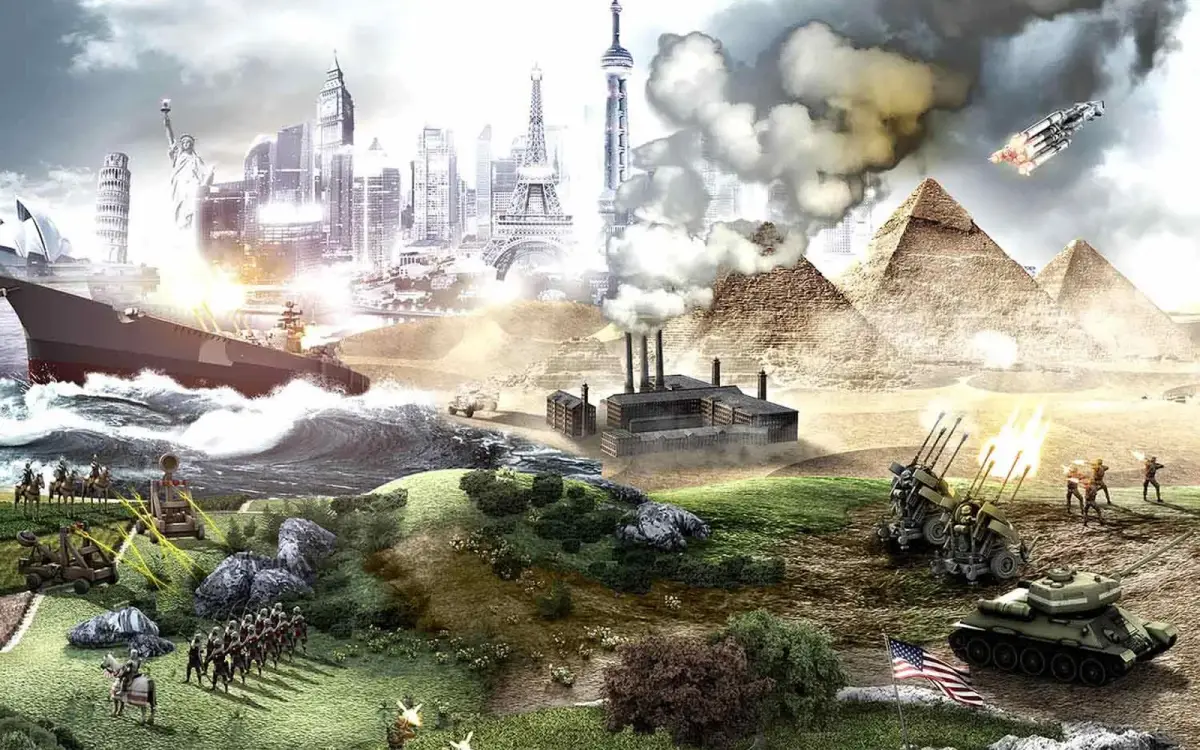
Learn how Militaristic City States function in Civilization V. Discover their benefits, how to manage them, and their strategic value in your empire.
Militaristic City States in Civilization V focus heavily on military might, offering free military units periodically. The type of unit provided depends on their available resources (like horses for chariots) and their technological level (infantry for high tech, warriors for low tech). Allied city states provide units more frequently.
When allied, you can control whether these city states spawn units. Disabling this feature stops unit production, while enabling it (the default) ensures you receive free units. This mechanic is straightforward.
Personally, Militaristic City States are considered moderately useful, ranking above Cultural but below Maritime City States. They generally require little upkeep, often having military units on their tiles. Their free units can appear at opportune moments, such as during an enemy declaration of war. However, the author's personal strategy is to protect them until they can be conquered.
Militaristic City States offer free units, with the frequency increasing with the strength of your friendship. They are less useful if your goal is not domination.
Almaty
Founded: 1854 AD
Location: South-Eastern Kazakhstan
Population: 1,348,500
Located near the south eastern border of modern-day Kazakhstan, Almaty has hosted human settlements from as early as 1000 BC. Its early history was one of farms and tribal herdsman, and it wasn't until the Middle Ages that Almaty began to prosper and flourish as a city, when it became an integral part of the Silk Road trade route. For three centuries Almaty thrived as a center for agriculture and crafts, but in the 13th century much of the city was destroyed by Mongol raids. By the 15th century, Almaty and the surrounding region found itself in a state of decline.
It wasn't later until 1854 that Almaty began to recover and build anew into the modern city it is today. Imperial Russia constructed Fort Zailiyskoye on the ancient site, later renaming it Fort Verniy. A year later the soldiers started accepting peasants and tradesmen to the area and formed the town of Verniy, which housed the administrative center of the newly created Semirechye province of Turkistan. For a brief thirty years this version of Almaty prospered again, only to be destroyed in less than twelve minutes by a catastrophic earthquake in 1887.
In the early 20th century, the town's name was changed to Alma-Ata. With the construction of the Turkestan-Siberia Railroad the city regained some of its former importance as a trade depot. The capital of Kazakhstan was moved to Alma-Ata in 1936, with the idea of remaking the city into a kind of cultural Mecca. In 1993 Alma-Ata's name was changed yet again to Almaty, (referencing the area's ample apple orchards).
In 1997 the government moved the country's capital to Astana - a city with far fewer threats of natural disasters. Despite this setback to its political importance and the constant threat of destruction from catastrophic mudflows, Almaty once again prospers as a cultural, financial, and industrial center.
Belgrade
Founded: 279 BC
Location: North-Central Serbia
Population: 1,630,000
The present capital of Serbia, Belgrade lies at the juncture of two of Europe's most important waterways, the Danube and Sava rivers, and has served as a major crossroad between Europe and Asia for centuries. Belgrade is one of the oldest cities in Europe, with settlements dating as far back as 6,000 BC, and may have been the home of the largest known prehistoric European culture, the Vincas. The first recorded fort and permanent settlement on this location was built by the Celts in the 3rd century BC, who named it Singidun, or Singidunum, "White Fortress".
Singidunum was ravaged and occupied by a large succession of peoples over the next couple of hundred years, including the Romans, Huns, Sarmatians, Ostrogoths, and Avars, before falling under Byzantium rule in the 9th century AD. This is when the city was given its Slavic name, Beligrad, which means "White Fortress." In the following centuries the city hosted the armies of both the First and Second Crusade and remained a contested battleground between Bulgaria, Hungary, and Byzantium.
In 1456, the Ottomans launched the famous Siege of Belgrade in an attempt to subjugate Hungary - the fall of the fortress at Belgrade would have opened a clear path for Sultan Mehmed II to take the heart of Central Europe. However, an army led by Hungarian John Hunyadi destroyed the Ottoman's forces and is credited not only with saving the city but also with preserving Christianity in Europe. To this day, Catholic churches still ring the church bells at noon in commemoration of the victory. Unfortunately, plague killed many of the victorious soldiers - including Hunyadi - in the weeks following their triumph. In 1521, nearly 70 years later, Sultan Suleiman the Magnificent finally captured the city, and it was made the seat of the Ottomans' Sanjak district and quickly became the second largest city in the Empire, eclipsed only by Constantinople.
The Second Serbian Uprising of 1815 (following a brief failed attempt in 1807) granted the Serbian region semi-independence, with full independence not achieved until 1878; the capital of this new kingdom was moved to Belgrade and the city once again prospered and grew rapidly. The city's growth was halted however wi
100% Human-Written. AI Fact-Checked. Community Verified. Learn how AntMag verifies content