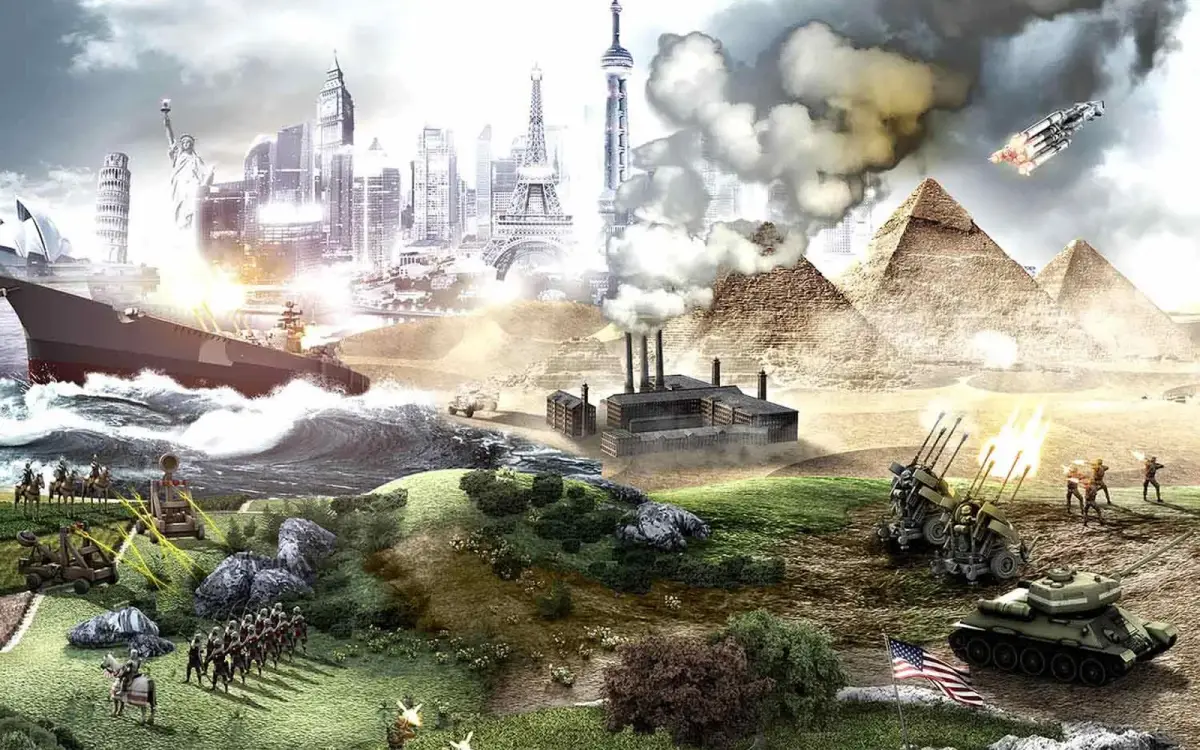
Explore French history in Civilization V, from Napoleon's rise to the impact of World War I and World War II.
The French Revolution saw the Catholic Church attacked and revolutionary forces crushed. In 1795, a new French constitution established executive power with "The Directory," a five-director panel elected annually by a bi-cameral legislature. This proved unmanageable, and in 1799, Napoleon Bonaparte seized power.
Born in Corsica and trained in artillery, Napoleon staged a coup d'etat in 1799, becoming First Consul. He crowned himself Emperor within five years and ruled France for sixteen years, transforming it into Europe's most powerful force. He repeatedly defeated other European nations, except England, due to his inability to match the British Navy. Napoleon's European campaigns lasted fifteen years until his defeat at Leipzig and later at Waterloo.
Following Napoleon's final defeat, a constitutional monarchy lasted about 40 years until Napoleon's nephew, Louis Napoleon, was elected president in 1848 and declared himself king in 1852. He ruled until 1870, when, provoked by Prussian Prime Minister Otto von Bismarck, he declared war on Prussia. This war was a disaster; Prussians utilized their rail network effectively, capturing Napoleon and his army on September 2, 1870. This led to the Third Republic, the loss of Alsace-Lorraine to Prussia/Germany, and a desire for revenge.
The First World War stemmed from complex European alliances. Initiated by Austria-Hungary's land-grab of Serbia, using the murder of an Arch Duke by a Serbian terrorist on June 28, 1914, as a pretext, the war escalated by August. The conflict pitted the Central Powers (Germany, Austria-Hungary, Ottoman Empire, Bulgaria) against the Triple Entente (United Kingdom, France, Russia). On the Eastern Front, Germany swiftly defeated Russia. On the Western Front, German advances were halted east of Paris by French and UK defenses. For four years, a 5000-foot trench line divided France, with immense casualties and gains measured in inches. Chemical warfare and the presence of unexploded ordnance poisoned the land. The United States entered the war in 1917, leading to German morale collapse and an armistice in 1918.
France suffered greatly from World War I, with two million dead and over four million wounded. The war-torn territory became a wasteland. Demands for huge reparations from Germany aimed to rebuild France and punish the enemy, but this embittered Germans and discouraged American involvement in European affairs.
The Second World War was a disaster for France. As Germany rebuilt its military, France, short on manpower, constructed the Maginot Line, a formidable defensive system on the German border. However, the Line did not extend to the sea for political reasons, leaving Belgium outside its defenses. The Belgians refused to fortify their border with Germany, allowing the German army to bypass the Maginot Line by invading through Belgium. The French and British failed to establish a stable defense against the German blitzkrieg, and France surrendered on June 22, 1940.
On June 6, 1944, Allied troops landed in Normandy, beginning the liberation of France. Despite stubborn German defenses, Soviet advances from the east, catastrophic troop losses, loss of air superiority, and relentless Allied bombing led to Germany's inevitable defeat. Paris was liberated on August 25, 1944, and Germany surrendered on May 7-8, 1945.
100% Human-Written. AI Fact-Checked. Community Verified. Learn how AntMag verifies content