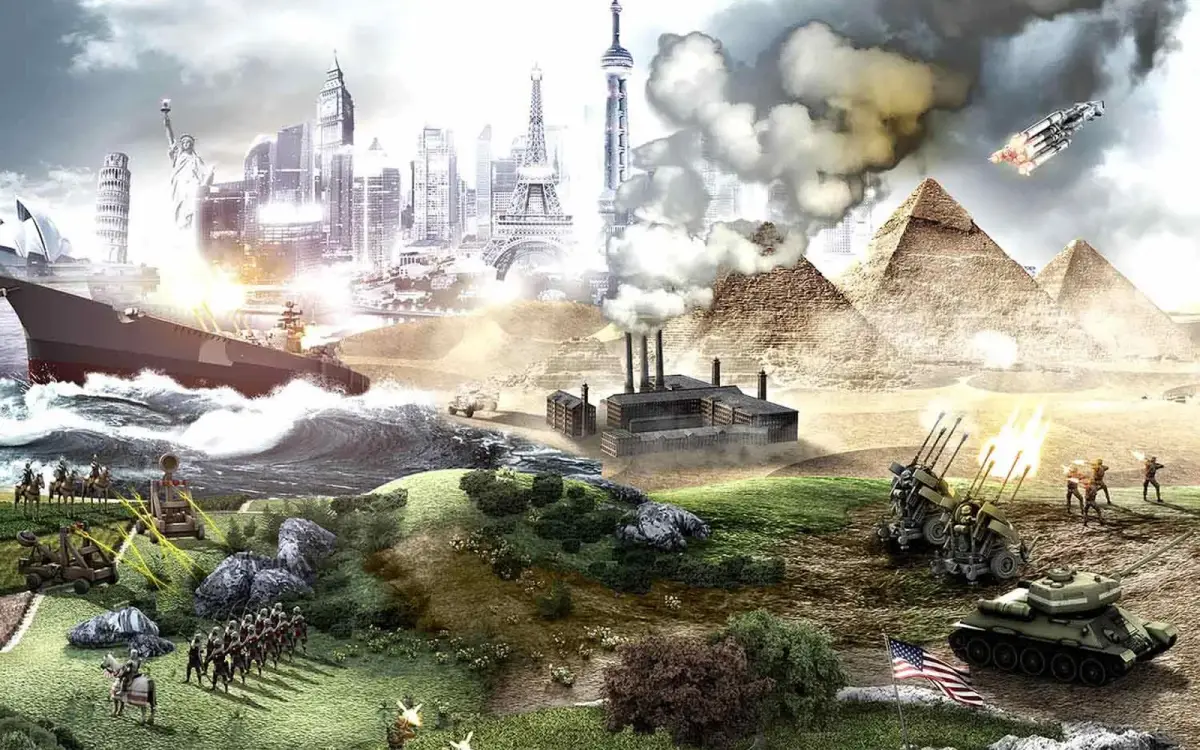
Learn about the Meiji Restoration in Civilization V, Japan's rise to power, and key conflicts like the Sino-Japanese War and Russo-Japanese War.
The Meiji Restoration was an extraordinary period where Japan, in less than a century, abolished feudalism, largely disbanded the Samurai class, and returned land ownership to farmers. The government successfully initiated a program of industrialization and adopted a constitution based on European models by the late 19th century. By the early twentieth century, Japan had become a major power in the Pacific, second only to the United States.
Key Conflicts and Expansion:
- Sino-Japanese War (1894): Japan fought China over Korea, winning nominal independence for Korea and gaining Formosa, the Liaotung Peninsula, and the Pescadores Islands. Japan also extorted unfair trade agreements from China. Western powers forced Japan to return the Liaotung Peninsula to China, which was then leased to Russia, infuriating Japan.
- Boxer Rebellion (1900): In response to Chinese citizens rising up against foreigners, western powers and Japan sent troops, slaughtering Chinese citizens and occupying more territory. Russia occupied Manchuria, which Japan viewed as a threat.
- Russo-Japanese War (1904): Japan attacked the Russian fleet without warning and achieved a spectacular victory, proving its ability to defeat a major western power. In the peace treaty, Japan received primacy in Korea and acquired Russia's possessions in China. President Roosevelt received the Nobel Peace Prize for brokering the treaty.
- World War I: Japan seized Germany's possessions in Asia and the Pacific. Post-war military treaties attempted to limit Japanese expansion while assuring its independence.
Rise of Militarism:
In the 1930s, militarists gained power in Japan, partly due to hardships from the Great Depression. Western and Chinese tariffs, along with anti-Japanese racism, limited Japan's export earnings, which were needed to purchase food. The militarists advocated for expansion through force to open foreign markets. In the late 1920s, the military increased operations in Manchuria without government approval, and the government was too weak to intervene.
Political Instability:
In May 1932, naval officers murdered the prime minister. In 1936, rebellious military units assassinated important politicians and took over central Tokyo. Though the rebellion was suppressed, the government's survival depended on the military's approval. Emperor Hirohito remained silent, fearing for the throne.
Deteriorating International Relations:
By the 1930s, relations with the USSR, England, and the United States worsened. The USSR resented its past defeat and hoped for a communist revolution in Japan. England and the US opposed Japan's policies in China and Korea and feared its growing naval power. In response to Anglo-American pressure, Japan signed mutual defense pacts with Germany and Italy in 1936 and 1940. In 1940, Japan signed a non-aggression pact with the USSR.
World War II:
After Germany attacked Russia in 1941, Japan occupied northern Indochina to block British supply routes. The United States responded by freezing Japanese assets and implementing an oil embargo. Japan chose war, opting to seize the oil fields of the Dutch East Indies rather than retreat.
World War II began with highly successful surprise attacks by Japan on Pearl Harbor and in the Philippines, nearly driving US forces from the Pacific. However, US industrial output and rapid learning allowed them to push Japan back across the Pacific over the next few years. In August 1945, the United States dropped atomic bombs on Hiroshima and Nagasaki.
- Pay close attention to the territorial gains and losses specified in the treaties following conflicts, as these directly impact your empire's borders and resources.
- The rise of militarism signifies a shift in AI behavior, potentially leading to more aggressive expansionist policies.
- International relations are crucial; monitor pacts and tensions to anticipate potential conflicts or alliances.
- The oil embargo by the United States is a critical turning point, forcing a strategic decision between diplomacy and war.
100% Human-Written. AI Fact-Checked. Community Verified. Learn how AntMag verifies content