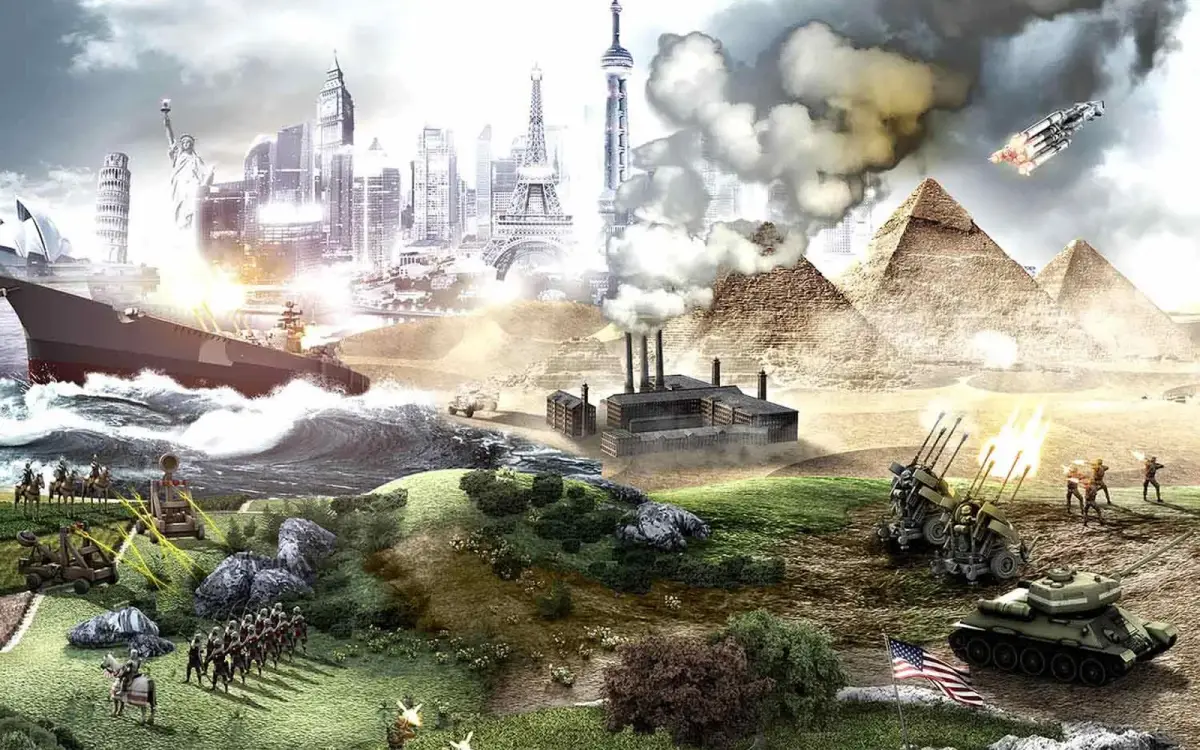
Explore the United States civilization in Civilization V, including its Manifest Destiny ability, B17 bomber, and the Minuteman unit.
The United States, a nation with significant influence on modern society, possesses strong unique abilities in Civilization V. Its Manifest Destiny ability increases sight range, which is invaluable for early-game scouting of new territories. It also allows for purchasing tiles at a discount, reflecting historical events like the Louisiana Purchase and annexations of Mexican lands, providing a useful boost, especially during proxy wars with other nations.
The B17 is the unique unit that replaces the standard bomber. It takes only half the normal damage from enemy interceptors and fighters, and receives a bonus against enemy cities. The iconic Minuteman replaces the Musketman. This unit has a movement cost of only 1 point on all terrain types, meaning there are no penalties when moving through hills or forest tiles.
George Washington
History
George Washington was a pivotal figure in the American Colonies during the late eighteenth century. While not as combative as John Adams, as imaginative as Benjamin Franklin, or as brilliant as Thomas Jefferson, Washington possessed exceptional leadership qualities in both war and peace. He led the Continental Army to victory against overwhelming odds, securing independence for his country.
A descendant of English colonists who settled in Virginia in 1657, George Washington was born into a family of considerable wealth and privilege for the time. As a young man, he studied subjects like mathematics, writing, geography, and likely Latin, but did not attend college. Instead, he focused on learning animal husbandry, farming, and estate management. Washington was also trained as a surveyor and spent several years mapping the lands in and around the Virginia colony.
In 1754, war erupted between England and its colonies against the French and their Native American allies. Washington participated in several engagements during this conflict, demonstrating courage and composure under fire, though not exceptional strategic brilliance. The war concluded with an English victory, and Washington resigned from the Colonial forces with the honorary rank of Brigadier General.
Following the war, Washington married and dedicated himself to managing his expanding estates, reportedly enjoying the work and participating in manual labor. He also served in the House of Burgesses in Williamsburg, Virginia's largely powerless local governing body, where real authority rested with the Royal Governor and the British Crown.
Although initially a loyalist, Washington grew increasingly resentful of the taxes imposed by Parliament on the Colonies, largely to cover (press the cover button to crouch behind walls or objects) debts from the French and Indian War. As tensions escalated, Washington's stance radicalized, and by 1768, he declared his readiness to fight England when called upon by his country. By 1774, he was a member of the Continental Congress. When hostilities began near Boston in 1775, Washington was appointed commander of the Colonial military forces, a role he maintained after independence was declared in 1776.
As military commander of the Revolutionary forces, Washington exhibited the same strengths and weaknesses seen in his earlier service fighting for England. He was personally brave, sometimes to the point of recklessness. Early in the war, he favored overly complex military strategies that exceeded the capabilities of his volunteer soldiers, leading to near-disastrous defeats against professional British forces. However, through sheer perseverance during years of hardship and setbacks, he kept his army viable and the revolution alive. The tenacity and developing skill of the Colonial Army and its general eventually earned grudging respect from their adversaries.
The entry of France into the war on the side of the Colonies, coupled with growing Colonial success on the battlefield, fueled anti-war sentiment in Britain. In 1781, Washington led his troops on a swift march into Virginia, where, with significant French assistance, they besieged an entire British army. French naval superiority allowed them to control the sea, preventing British escape and forcing the surrender of their command at Yorktown. While minor fighting continued for several months, the war was effectively over, with America achieving independence.
After the war, Washington presided over the Constitutional Convention, shaping the new nation's government, and subsequently served as its first President. As President, Washington aimed to keep the country free from foreign entanglements and resisted close alliances or wars. He also attempted, with limited success, to mitigate political party rivalries. Washington served two four-year terms before retiring to his Mount Vernon estate in Virginia, where he died two years later in 1797.
George Washington is rightfully known as the "Father of the United States of America." While not the greatest general or statesman in world history, Washington possessed remarkable leadership capabilities.
100% Human-Written. AI Fact-Checked. Community Verified. Learn how AntMag verifies content