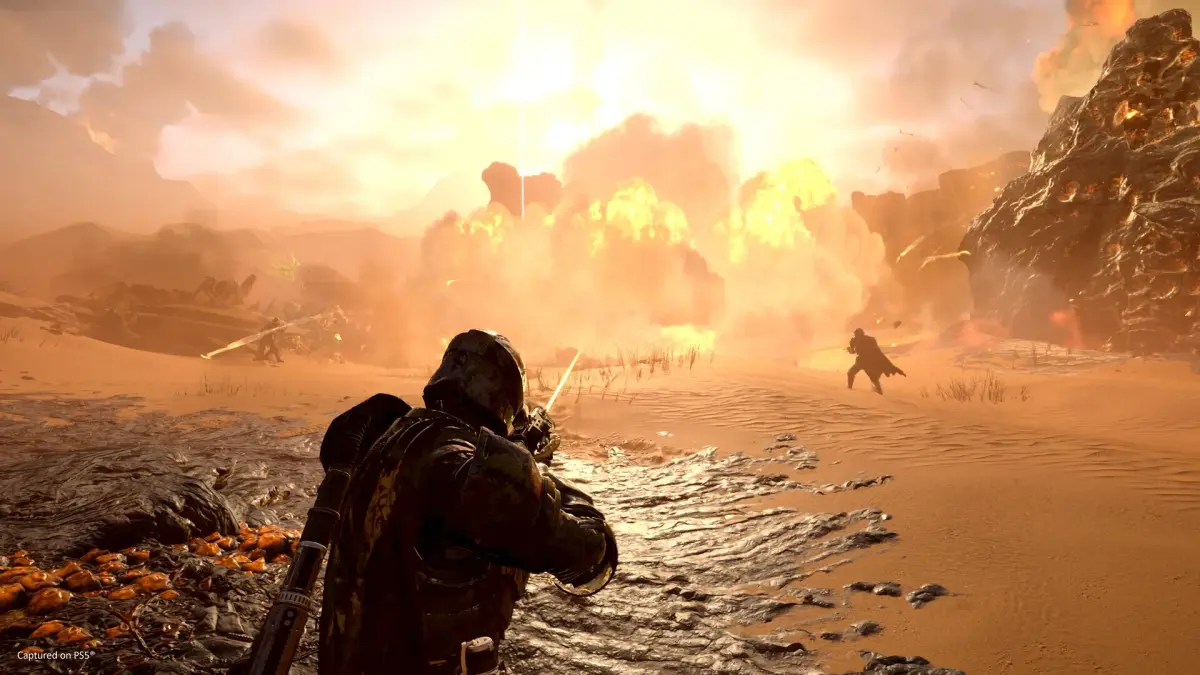
Master Helldivers 2 squad formations. Learn wedge, line, column, box, and scatter formations for effective combat, defense, and objective completion.
Effective squad formations are the bedrock of successful operations in Helldivers 2. Moving as a cohesive unit, rather than a scattered mob, significantly enhances survivability, firepower, and objective completion. This guide explores various formations and when to employ them to best serve Super Earth.
The Importance of Squad Formations
In the chaotic crucible of Helldivers 2, a well-organized squad is far more effective than a disorganized one. Proper formations ensure:
- Mutual Fire Support: Everyone can cover different angles and provide covering fire for their teammates.
- Reduced Friendly Fire: Clear lines of sight and designated roles minimize accidental team kills.
- Efficient Objective Completion: Coordinated movement allows for faster traversal and simultaneous engagement of objectives.
- Enhanced Situational Awareness: Each Helldiver can focus on a specific sector, providing better overall battlefield awareness.
- Improved Survivability: A tight formation can concentrate defensive firepower and allow for quicker revives.
Common Squad Formations
1. The Wedge (or Arrowhead)
Description: One Helldiver leads, with two Helldivers slightly behind and to the sides, and the fourth Helldiver at the rear.
When to Use: Ideal for advancing into unknown territory, clearing paths, or moving through areas with potential ambushes from the front or sides. The lead Helldiver scouts, while the flanking members provide early warning and cover.
Pros: Good forward observation, strong frontal and flank defense, allows for quick reaction to threats from multiple directions.
Cons: Vulnerable to attacks from the rear if the rear Helldiver is not vigilant.
2. The Line (or Skirmish Line)
Description: Helldivers spread out horizontally, facing the same direction, with some spacing between them.
When to Use: Best for assaulting a fortified position, defending a wide perimeter, or advancing across open ground where threats are primarily frontal. It maximizes frontal firepower.
Pros: Excellent for concentrated frontal assault, good for covering a wide area, allows for focused fire on a single objective.
Cons: Vulnerable to flanking maneuvers and attacks from the rear. Requires good communication to avoid friendly fire.
3. The Column (or File)
Description: Helldivers move one behind the other in a single file line.
When to Use: Useful for navigating narrow corridors, dense terrain, or when speed is paramount and the threat is primarily from the front. Also good for moving through areas with known hazards.
Pros: Efficient for moving through tight spaces, easy to maintain formation, good for quick retreats.
Cons: Very vulnerable to flanking and rear attacks. Limited field of fire for most members.
4. The Box (or Diamond)
Description: Four Helldivers form a square or diamond shape, with each member covering a different quadrant.
When to Use: Excellent for escorting mobile objectives, defending a stationary point, or when facing threats from all directions. It provides 360-degree coverage.
Pros: Excellent all-around defense, good for protecting vulnerable assets, allows for quick reaction to threats from any direction.
Cons: Can be slower to advance, requires good coordination to avoid friendly fire within the formation.
5. The Scatter (or Dispersed Formation)
Description: Helldivers spread out significantly, maintaining visual contact but not adhering to a strict formation. Often used during extraction defense.
When to Use: Ideal for defending extraction zones or large areas where enemies can approach from multiple vectors and cover is abundant. Allows for individual engagement and better use of terrain.
Pros: Maximizes use of cover, allows for individual engagement, harder for enemies to pin down the entire squad.
Cons: Can lead to reduced squad cohesion and communication if not managed well. Risk of friendly fire increases if not careful.
Implementing Formations
- Communicate Your Intent: Before moving, announce the desired formation and direction.
- Designate Roles: Ass who will lead, who will cover flanks, and who will watch the rear.
- Maintain Spacing: Don't bunch up too tightly, especially with explosive weapons or stratagems.
- Adapt to Terrain: Be flexible. The best formation might need to change based on the environment.
- React to Threats: If ambushed, quickly revert to a defensive formation or scatter to use cover effectively.
Example Scenario: Advancing on an Automaton Base
Your squad is approaching a heavily fortified Automaton base. Threats are expected from the front and potentially from the flanks.
- The squad adopts a Wedge formation to advance, with the lead Helldiver scouting for mines and initial defenses.
- As they get closer, they transition to a Line formation to bring maximum firepower to bear on the base's defenses.
- If they encounter heavy resistance from multiple sides, they might shift to a Box formation to defend their position and call in stratagems.
- During extraction, they might adopt a Scatter formation around the extraction zone to cover all approaches.
By mastering these formations and communicating effectively, your squad will become a well-oiled machine, capable of overcoming any challenge Super Earth throws at you. For Managed Democracy!
100% Human-Written. AI Fact-Checked. Community Verified. Learn how AntMag verifies content