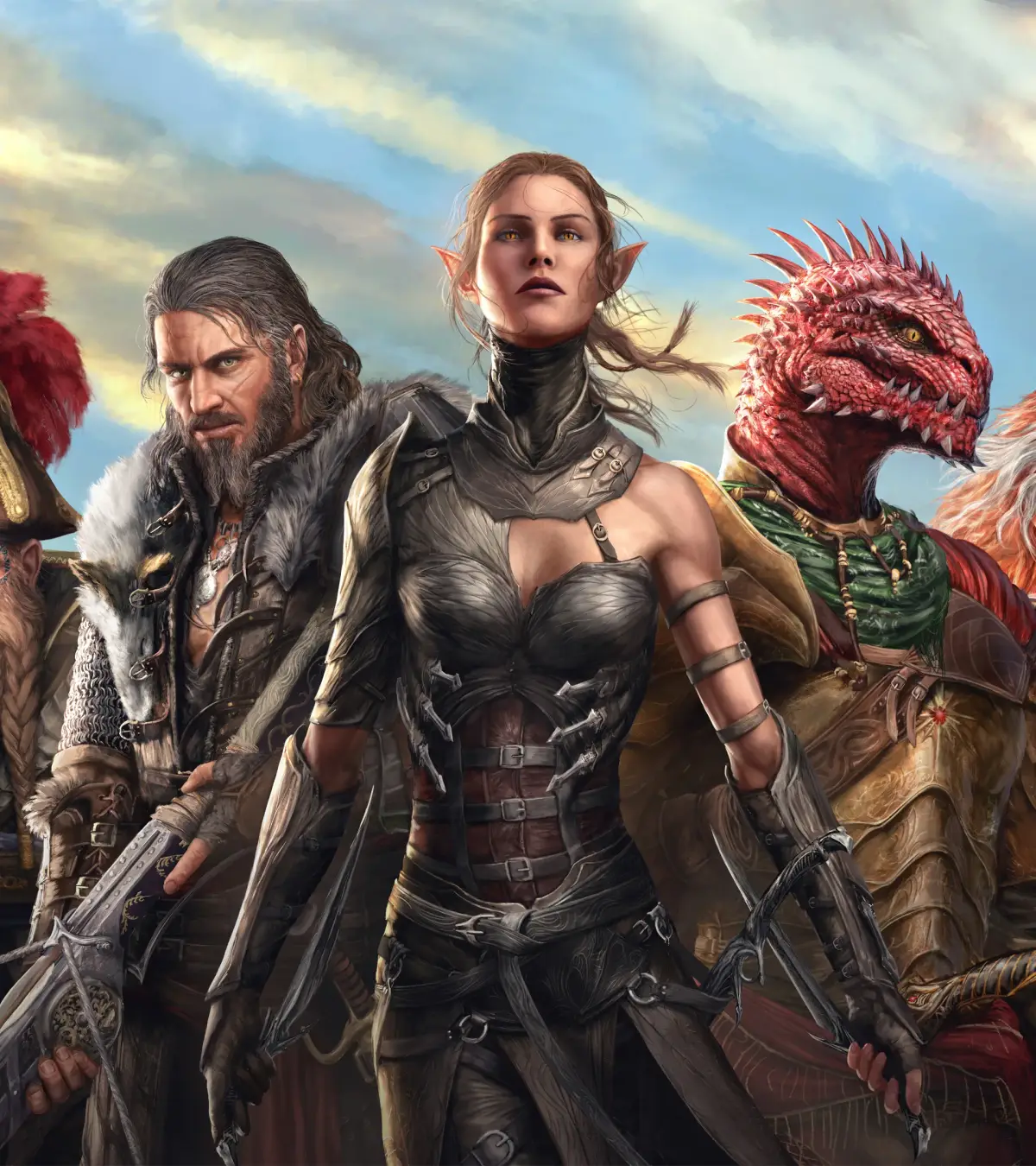
Welcome to Rivellon! Divinity: Original Sin 2 is a massive RPG where you'll forge your own path as a powerful Sourcerer, navigating a world rife with political intrigue and divine ambition. You'll explore vast regions, master intricate combat systems, and make choices that shape the very fate of existence. It’s a deep, rewarding experience perfect for solo adventurers and co-op parties alike.
This guide is your essential companion for conquering every challenge Larian Studios throws your way. We’ll break down everything from building your perfect character and tackling early game hurdles to surviving the epic final confrontation. Get ready to dive deep into key areas, master vital skills, and overcome unforgettable boss encounters across the entirety of Divinity: Original Sin 2.
Mechanics
Learn about Action Points, Initiative, Armour, Vitality, and damage calculation in Divinity: Original Sin 2. Understand how combat works.
- 1Combat in Divinity: Original Sin 2 is turn-based, with your actions limited by Action Points (AP). You start with 4 AP, which recharge at 4 AP per turn.
- 2Movement costs 5m per 1 AP. Using a 1 AP ability costs 1 AP.
- 3Basic weapon attacks cost 2 AP. Using a 2 AP ability costs 2 AP.
- 4Using a 3 AP ability costs 3 AP.
- 5Sources of additional AP include Adrenaline (+2 AP this turn, -2 AP next turn), Executioner (+2 AP after killing an enemy, once per turn), Flesh Sacrifice (+1 AP), Haste (+1 AP per turn), Lone Wolf (+2 AP and +2 AP Recovery), The Pawn (+1 AP for movement only), and What a Rush (+1 AP and +1 AP Recovery while below 50% Vitality).
- 6The Elemental Affinity talent does not grant additional AP but can reduce the AP cost of certain abilities.
- 7Initiative determines turn order, calculated by your Wits attribute and gear bonuses. The character with the highest Initiative goes first. Turn order within your party is based on individual Initiative scores. If your party's highest Initiative matches an enemy's highest Initiative, the enemy goes first.
- 8Enemies and characters have three health bars: Physical Armour, Magic Armour, and Vitality.
- 9To kill a creature, you must reduce their Vitality to 0. Attacking Vitality requires first reducing either Physical Armour or Magic Armour to 0. Some abilities and weapons can attack Vitality directly.
- 10When Armour is reduced to 0, a creature becomes vulnerable to crowd control effects like Knockdown and Stun. The Torturer talent allows inflicting damage-over-time effects without stripping armour first.
- 11Armour is primarily from equipment, but abilities like Fortify and Armour of Frost can add to your Armour value. Vitality is mainly based on character level, increased by Constitution (+7% per point over 10) and the Picture of Health talent (+3% per point of Warfare).
- 12Accuracy is your base chance to hit, opposed by the target's Dodging. Hit Chance = (Accuracy - Dodging) × (1 - Block Chance). Base Accuracy is 95%.
- 13Accuracy can be increased by the Single-Handed weapon ability and the Hothead talent. Base Dodging is 0% and can be increased by the Sturdy racial talent, Dual Wielding, Leadership, and Parry Master talent. Shields can provide Block Chance.
- 14Damage calculation: Total damage = Base x (1 + High Ground Bonus) x (1 + Warfare Bonus) x (1 + Attribute Bonus + Weapon Bonus). Warfare and high ground bonuses are multiplicative; attribute and weapon bonuses are additive. Base weapon damage depends on weapon level.
- 15Critical Hits have a base Critical Chance of 0% and can be increased by weapon properties, Wits, Ingenious trait, Ranged weapon ability, and Hothead talent. Base Critical Multiplier is 150%, increased by weapon properties, Ingenious trait, Scoundrel ability, and Two-Handed weapon ability.
- 16Early game, damage bonuses from Attribute points and weapon abilities scale better than Critical Chance and Critical Multiplier. For example, +5% Damage equals +5% Damage, while Ingenious trait (+5% Critical Chance and +10% Critical Multiplier) equals approximately +3% Damage.
- 17Later in the game, when Critical Chance is high, Critical Multiplier becomes more beneficial. For instance, if Strength gives +200% damage, a +5% damage increase is less impactful than multiplying the damage by an additional 0.05.
- 18Equipment in Divinity: Original Sin 2 is levelled, meaning items found and bought become stronger as you progress. Loot in regions is pegged to that region's level, while merchants' inventories are pegged to your current character level.
- 19Item rarity levels are: Common, Rare, Epic, Legendary, Divine (seen at level 16+), and Unique. Higher rarity means more and better properties.
- 20Equipping a weapon higher than your character level incurs a -10% Accuracy penalty for each level difference. Other equipment slots do not have this penalty.
- Prioritize increasing your Initiative to ensure your party acts before enemies.
- Focus on stripping Armour before attempting to apply crowd control effects.
- Consider the trade-off between Critical Chance and Critical Multiplier bonuses based on your current game progression.
- Keep your equipment level close to your character level to avoid Accuracy penalties.
Tips
Master Divinity: Original Sin 2 with essential tips on crafting, combat, character creation, and early game gold management.
- 1Disable unwanted automated hotbar additions in Options / Game / Automated Hotbar Behaviour to prevent clutter, especially for items like potions and arrows. Manually add these to a dedicated hotbar section.
- 2Hold the X button while exploring to highlight nearby pick-up items and interactable objects.
- 3When speaking to NPCs, open the trade interface (△ button) before looting their remains later, as you can then take their trade items.
- 4Have companions initiate conversations to leverage their racial bonuses. For example, use the Red Prince for persuasion checks (+1 Persuasion) or Lohse/Ifan for bartering (+1 Bartering).
- 5In the early game, prioritize spending gold on skillbooks. Craft an Improvised Staff (Long Branch for 2G + free Shell) to sell for ~50G at level 3.
- 6To afford second-tier skillbooks by level 4, steal them. Create a dedicated thief character by selecting the Shadowblade preset (for Thievery) and taking All Skilled Up at level 3 for three Thievery points.
- 7Before attempting to steal, quick save to avoid making NPCs hostile. Exercise extreme caution on Honour Mode.
- 8Craft nails into boots to walk on frozen surfaces without slipping. Always carry a knife, hammer, and mortar and pestle.
- 9Load a Strength-invested character with a Water Barrel, Oil Barrel, and Ooze Barrel for readily available sources of water, oil, and poison. Acquire as many nails as possible in the first area as they become rare later.
- 10You only need one Identifying Glass; give it to the character with the highest Loremaster value to identify all rare items.
- 11Similarly, one Bedroll is sufficient for the entire party. Add it to your hotbar to fully heal and gain the Rested buff outside of combat.
- 12Use the Spirit Vision skill whenever you encounter a dead body to converse with their spirit.
- Elven racial abilities, particularly Flesh Sacrifice, are very strong, synergizing well with ranged attackers (Elemental Arrowheads) and Necromancers (Elemental Affinity).
- When allocating attributes, focus on a single damage attribute (Strength, Finesse, or Intelligence). Add points to other attributes only for gear requirements and Memory for skill slots. Constitution is mainly for shield users. Put spare points into Wits.
- For combat abilities, specialize in Warfare for physical damage builds (melee, ranged, rogue, Necromancer). Invest only enough points in other abilities (Huntsman, Scoundrel, Pyrokinetic, Aerotheurge) to unlock desired skills. For example, one point in Warfare unlocks Executioner, two points in Huntsman unlock First Aid and Tactical Retreat, and two points in Scoundrel unlock Adrenaline and Cloak and Dagger. One point in Pyrokinetic unlocks Haste and Peace of Mind.
- Undead characters are harmed by healing but healed by poison, which can be a mixed blessing for the party.
- When stealing, quick save first to avoid accidentally angering NPCs.
Difficulty
Unravel the mysteries of Divinity: Original Sin 2's difficulty settings. Master Classic, Explorer, Story, Tactician, and Honour modes with our expert guide.
Alright, let's talk about how tough you want your journey through Divinity: Original Sin 2 to be. The game actually gives you a good range of options, letting you tailor the experience from a breezy stroll to a nail-biting challenge. You've got your standard modes, plus a couple of special ones that really shake things up.
Here's the breakdown of what each mode offers:
- Classic Mode: This is your baseline, the default experience. No special buffs for you, no nerfs for the bad guys. It's the standard adventure as the developers intended.
- Explorer Mode: Feeling a bit overwhelmed or just want to focus on the story? Explorer Mode is your friend. It gives your allies a significant boost (+50% Vitality, +50% Damage, +30% Armour, and better hit/dodge chances) while dialing back the enemies (-20% Vitality, -30% Damage, -30% Armour, and worse hit chances). It's a much more forgiving playthrough.
- Story Mode: If Explorer Mode still feels a little too spicy, Story Mode cranks the dial even further. Your allies get a massive buff (+100% Vitality, +100% Damage, +50% Armour, and improved hit/dodge), and enemies are significantly weakened (-40% Vitality, -50% Damage, -50% Armour, and worse hit chances). Plus, you get the handy ability to resurrect fallen allies with full health, making those tough fights much more manageable.
- Tactician Mode: Ready to test your mettle? Tactician Mode is where things get serious. Enemies become much stronger (+50% Vitality, +50% Damage, +2% Damage per level, +50% Armour, +1.5% Armour Growth per level, +35% Magic Armour, +1.5% Magic Armour Growth per level, and a +10% chance to hit). On top of that, merchants will charge you more for their wares, so every Gold counts.
- Honour Mode: This is the ultimate challenge, often chosen alongside Tactician Mode. Honour Mode throws a brutal restriction at you: you only get one save file. If your entire party wipes out, that's it – your run is over, and you have to start from scratch. While you can technically back up your save file before a tough encounter, the game autosaves after any party member death, making it incredibly risky. It's for those who crave the ultimate test of skill and nerve.
- If you're new to Divinity or CRPGs in general, starting with Explorer or even Story Mode is a great way to learn the ropes without constant frustration.
- Classic Mode offers a balanced experience that's still challenging but fair for most players.
- Tactician Mode is for players who have a good grasp of the game's mechanics and want a significant challenge.
- Honour Mode is strictly for the hardcore players who want to prove they can conquer the game under the most punishing conditions.
Guide and Walkthrough (PS4) by chris-williams
Comprehensive guide and walkthrough for Divinity: Original Sin 2, covering game mechanics, character creation, skills, builds, and a step-by-step journey from prisoner to godhood on PS4.
This guide and walkthrough for Divinity: Original Sin 2 (PS4) covers the game's mechanics, character creation, skills, and provides a detailed walkthrough for the game's main story. It is aimed at Classic/Tactician difficulty and includes tips for a smoother playthrough.
The game is set after the Chaos War and the death of Lucian, the Divine. The Veil between worlds is weakened, allowing Voidwoken creatures to emerge. The Divine Order, led by Alexandar, has outlawed Source Magic, deeming it the cause of these incursions. Sourcerers, individuals attuned to Source Magic, are persecuted by the Magisters, shackled, and sent to the penal colony of Fort Joy. The player is one such Sourcerer on a transport to Fort Joy.
Developed by Larian Studios, Divinity: Original Sin II is a sequel to Divinity Original Sin, released in September 2017 and achieving significant sales and critical acclaim for its writing, worldbuilding, and tactical gameplay. A Definitive Edition followed a year later.
This walkthrough is divided into sections covering:
- Introduction (Mechanics, Tips, Difficulty, Copyright)
- Character Creation (Race, Origin Characters, Attributes, Abilities, Talents, Presets)
- Skills (Warfare, Huntsman, Scoundrel, Pyrokinetic, Hydrosophist, Aerotheurge, Geomancer, Necromancer, Summoning, Polymorph, Sourcery)
- Character Builds
- Chapter walkthroughs (Chapter 1 to Chapter 7)
- Items (Equipment, Unique Weapons/Armour/Accessories, Runes)
- Crafting
- Appendix: Technical Eggstacy
- Trophies
The walkthrough proper covers the journey from prisoner to godhood, with enemy stats based on Classic difficulty. PS4 controls are specified where applicable.
Additionally, the guide mentions 'Gift Bags,' official mods that can alter gameplay, which can be enabled from the pause menu but disable trophies.
Similar guides you might like




100% Human-Written. AI Fact-Checked. Community Verified. Learn how AntMag verifies content