
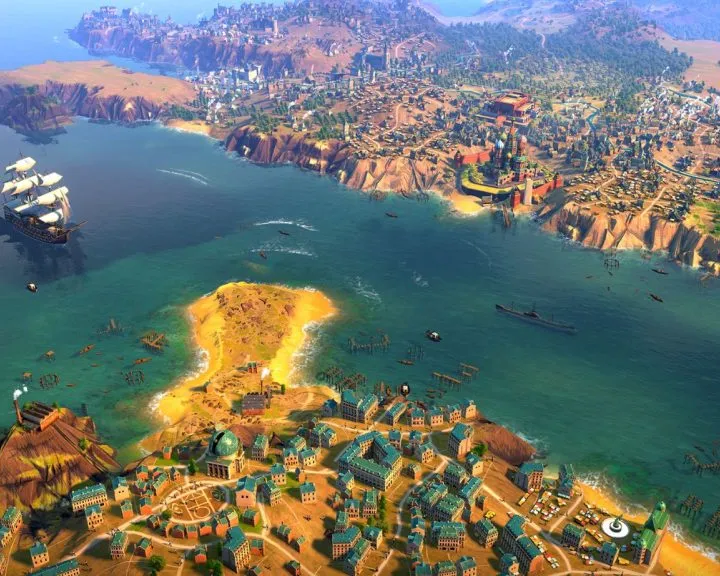
Master cooperative multiplayer in Humankind. Learn how to coordinate your empire's growth and share victories with allies through effective team strategy.
Cooperative multiplayer in Humankind offers a unique opportunity to forge an empire alongside friends or allies, tackling the challenges of history as a unified force. This mode shifts the focus from direct competition to collaborative strategy, where players pool their resources, knowledge, and efforts to achieve common goals. The core objective in co-op is to work together to overcome AI opponents or other player teams, aiming for victory conditions that benefit the entire alliance. This often involves a division of labor, where each player specializes in certain aspects of empire management based on their chosen cultures and strategic preferences. For instance, one player might focus on rapid expansion and military might, securing territory and defending the alliance's borders, while another player might dedicate their efforts to scientific research and technological advancement, unlocking powerful new units and infrastructure for the team. A third player could focus on cultural development and religion, generating influence and faith to support the alliance's overall progress and potentially achieve a cultural victory.
Effective communication is the cornerstone of successful cooperative play. Players must constantly share information about their progress, their opponents' actions, and their strategic intentions. This can involve discussing which Era Stars to prioritize, coordinating attacks or defenses, and planning city placements to maximize synergy. For example, if one player's city is strategically located near a valuable resource deposit, another player might choose to establish an outpost nearby to exploit that resource, with an agreement to share the benefits. The game's mechanics, such as the ability to trade resources or share vision, become invaluable tools in a co-op setting. You can ensure that their allies have the necessary FIMS (Food, Industry, Money, Science) to achieve their goals, or they can coordinate scouting efforts to gain a comprehensive understanding of the map and enemy positions. The stability of cities is also a shared concern; if one player's empire is suffering from low stability, allies can provide support through religious influence or by stationing defensive units nearby. The transition between cultures also presents cooperative opportunities. You can select cultures that complement each other, creating a more robust and versatile civilization. For example, an alliance might benefit from one player choosing a culture that excels in early exploration and expansion, while another chooses a culture that provides strong bonuses to industry or science in later Eras.
The challenges in cooperative multiplayer often stem from coordinating diverse playstyles and managing the shared victory conditions. Players must agree on a long-term strategy and be willing to make compromises for the good of the alliance. For instance, if the alliance is pursuing a scientific victory, players might need to prioritize research over military expansion, even if one player has a strong inclination towards warfare. The AI opponents can also present significant challenges, especially on higher difficulties. Coordinating defenses against a powerful AI assault or launching a joint offensive requires careful planning and execution. The game's turn-based nature allows for detailed planning, but the pressure of a ticking clock and the need for synchronized actions can be intense. Ultimately, cooperative multiplayer in Humankind is about building a shared legacy, where the combined strengths of the players create an empire that can stand the test of time, leaving a unique mark on the world.
[/NODE_1] [NODE_3]Competitive Multiplayer Tactics
Competitive multiplayer in Humankind demands a sharp strategic mind and the ability to adapt to the unpredictable actions of human opponents. Unlike AI, which often follows predictable patterns, human You can employ cunning tactics, unexpected strategies, and exploit any perceived weakness in your civilization. The early game is particularly crucial, as establishing a strong foundation can set the tone for the entire match. This involves efficient exploration to discover valuable resource nodes and potential city locations, as well as scouting to identify your neighbors and their initial cultural choices. For instance, if an opponent chooses the Egyptians for their early stability bonuses, they might be less aggressive in the Ancient Era, allowing you to expand more freely. Conversely, if they pick the Sumerians for their early war bonuses, you'll need to prioritize defensive measures or a preemptive strike.
A key tactic in competitive multiplayer is the strategic pursuit of Era Stars. Each Era presents multiple opportunities to earn these stars, and consistently achieving them before your opponents is vital for victory. This requires a balanced approach, as neglecting any category—Exploration, Expansion, Exploitation, Warfare, or Culture—can leave you vulnerable. For example, focusing solely on Warfare might lead to early territorial gains, but if you neglect Science, you could find yourself outmatched by technologically superior opponents in later Eras. Conversely, a purely scientific approach might yield advanced technologies, but without sufficient Industry or Expansion, you may lack the means to produce the necessary units or infrastructure to utilize them effectively. Understanding the strengths and weaknesses of your chosen cultures and how they synergize across Eras is paramount. A player who starts with a culture that excels in early expansion might transition to a culture that provides strong economic or scientific bonuses in later Eras to capitalize on their initial territorial advantage. This adaptability is crucial for outmaneuvering opponents who may be locked into a less flexible development path.
Diplomacy, even in a competitive setting, can be a powerful tool. While outright betrayal is always a possibility, temporary alliances, non-aggression pacts, or even strategic trade agreements can buy valuable time for development or allow for a focused assault on a common enemy. Players must constantly assess the political landscape, identifying potential allies and threats. For example, if two players are being aggressively encroached upon by a third, they might form a temporary alliance to repel the common threat, only to turn on each other once the immediate danger has passed. The management of FIMS (Food, Industry, Money, Science) is also critical. Efficient population assignment to maximize yields from your cities is essential. Over-allocating population to Food might lead to rapid population growth but can starve your Industry or Science. Conversely, neglecting Food can lead to low stability and potential revolts, which opponents can exploit. The game's Districts and Infrastructure mechanics also offer strategic depth. Building specialized Districts can accelerate progress in key areas, but ensuring they are well-connected by Infrastructure is vital for efficiency. A player who neglects infrastructure might find their highly developed cities isolated and inefficient, making them an easy target for an opponent with superior logistical capabilities.
100% Human-Written. AI Fact-Checked. Community Verified. Learn how AntMag verifies content