
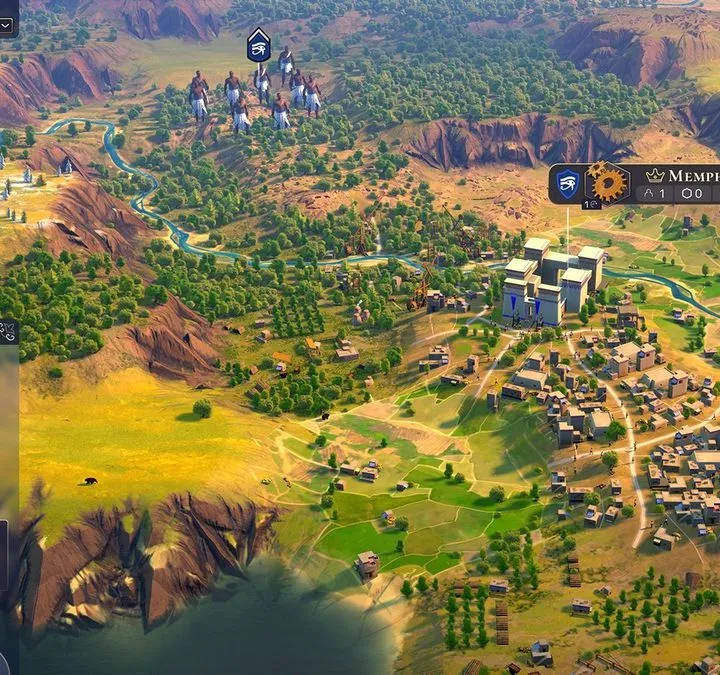
Begin your Humankind journey with effective early game strategies. Secure resources and expand your territory for future dominance.
The initial turns of Humankind are critical for setting the foundation of your civilization. A strong start can provide significant advantages throughout the game, influencing your ability to expand, research, and engage in conflict. This section will outline key early-game strategies, focusing on exploration, city placement, initial unit production, and the first steps towards developing your economy and technology. Mastering these early-game mechanics will allow you to establish a dominant position and prepare for the challenges of later eras. The choices made in the Neolithic and Ancient eras can have a ripple effect, shaping your civilization's trajectory for centuries to come.
Upon starting a new game of Humankind, your first actions will revolve around exploration and establishing your initial settlement. The game begins in the Neolithic Era, where your primary goal is to find a suitable location for your first city and begin gathering resources. Scouting is paramount; use your initial scouts to explore the surrounding territory, identify potential threats, and locate valuable resource nodes. The placement of your first city is a decision that should not be taken lightly. Look for locations with access to multiple food resources to support population growth, as well as proximity to industry and money-generating tiles. The terrain itself can also offer advantages or disadvantages, so consider factors like defensibility and access to rivers or coastlines. Once your city is founded, the focus shifts to efficient resource management and early development.
Exploration and Scouting
Your initial units in Humankind are typically a scout and a warrior. The scout is your primary tool for early exploration. Its speed and ability to traverse various terrain types make it invaluable for uncovering the map. Use your scout to identify nearby tribal villages, which can provide valuable early-game bonuses such as resources, technologies, or even new units. Scouting also helps you locate potential expansion sites for future cities and identify the locations of rival civilizations. Understanding the map and the positions of your neighbors is crucial for both diplomatic and military planning. The warrior unit, while primarily for defense, can also be used to clear out minor threats like barbarians or to secure valuable resource nodes. Prioritize exploring the immediate vicinity of your starting location before venturing too far afield, ensuring you have a good understanding of your local environment.
City Founding and Placement
The founding of your first city is a pivotal moment. Aim to settle on a tile that offers a good balance of FIMS yields. Ideally, your city should be adjacent to multiple food sources (like plains or rivers) to support rapid population growth. Proximity to industry tiles (like hills or forests) is also important for early building construction. Consider the defensive capabilities of the location; settling on a hill or near a river can provide defensive bonuses. Avoid settling too close to barbarians or aggressive neighbors if possible. Once founded, your city will begin generating basic FIMS. The first buildings you construct should focus on boosting these yields, such as a Granary for food and a Market for money. The number of tiles within your city's initial influence is limited, so strategic placement of districts and infrastructure is key from the outset. Expanding your city's influence through population growth and civic choices will be a continuous process.
Initial Unit Production and Development
After founding your first city, your next priority is often to produce more units. A second warrior can help secure your territory and clear out threats more efficiently. Alternatively, producing another scout can accelerate your exploration efforts, allowing you to discover more tribal villages and potential city sites faster. The decision of what to build next depends heavily on your immediate surroundings and the actions of your neighbors. If you encounter aggressive barbarians or a hostile neighbor, prioritizing military units is essential. If the coast is clear, focusing on economic buildings like a Workshop to boost industry or a Granary to increase population growth might be more beneficial. The early game is a delicate balance between expansion, defense, and economic development, and your initial build choices will significantly impact your ability to achieve these goals.
100% Human-Written. AI Fact-Checked. Community Verified. Learn how AntMag verifies content