
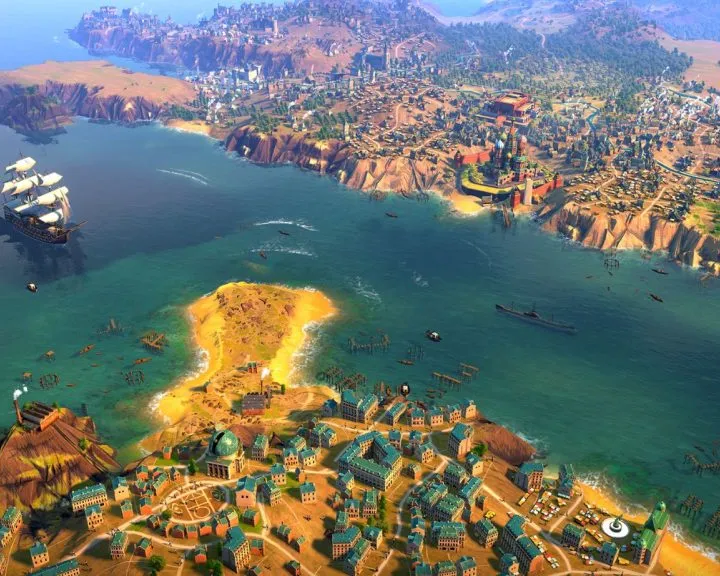
Learn how to navigate Feudalism and Vassalage in Humankind. This guide covers strategies for managing AI bonuses, early game survival, and achieving victory through Fame.
This item has been removed from the community because it violates Steam Community & Content Guidelines. It is only visible to you. If you believe your item has been removed by mistake, please contact Steam Support.
This item is incompatible with HUMANKIND™. Please see the instructions page for reasons why this item might not work within HUMANKIND™.
Preface
Updated on 9/19/2021.
This document is meant to serve as a general guide on beating Humankind on its highest difficulty. I love the Civilization series(really the 4x genre in general), and believe Humankind has the potential to exceed it in the future. I've beaten this game several times on its highest difficulty and wish to share my experiences. At the time this was written, the game has only recently released and is likely subject to much change - updates may invalidate much of what is written here.
Humankind Difficulty and General Strategy
As described here: https://humankind.fandom.com/wiki/Difficulty
Though the player suffers no penalty themselves, on the highest difficulty the AI are given the following bonuses:
- +3 Food per Farmer on all Cities
- +3 Industry per Worker on all Cities
- +3 Money per Trader on all Cities
- +3 Science per Researcher all on Cities
- +60 Stability on all Cities
- +2 Strength Combat Strength on all Units
Note that the FIMS bonuses are all flat values that scale with workers. Because these bonuses are flat rather than percentage based, they tend to not scale well. For example, early on in a city with with 9 population with 3 workers, the +9 industry would require potentially 3+ Industry Districts to offset. In contrast, if a late game AI city has 60 population, 15 of which are workers, that would amount to a +45 industry bonus. A +45 industry bonus is easily offset by half of a Strip Mine or a single Jama Masjid. What this means is that the player will be at a severe disadvantage early in the run, and due to the way the FIMS bonuses scale the run should in theory become easier over time.
The combat strength bonus is significant, and comparable to the difference between a given culture's emblematic unit and a normal unit(ie. swordsmen vs Shotelai) and basically impossible to offset during the neolithic/ancient era, and thus essentially means combat should be avoided during the first two eras. As the game progresses, electing to use the Professional Soldiers Civic and leaning towards the Homeland ideology axis will balance this deficit out.
The effect of the bonus stability is difficult to measure - but it almost certainly scales in such a manner that it decreases as the game progresses and you get access to more sources of stability. The strategy to compensate for this is mostly by trading for luxury resources.
The general strategy is thusly:
- Do not engage in war early on(until classical at the earliest, usually medieval).
- Establish trade for luxury resources.
- Grab Agrarian and Builder cultures early on and scale into late game where AI FIMS bonuses fall off. Scaling is most easily accomplished by building wide rather than tall.
- Win the game by acquiring as many stars/fame as possible. Please note that because of the way Fame works it is generally not optimal to immediately transcend cultures, as you will likely only earned a fraction of that era's available stars and thus miss out on opportunities to earn fame. It is very possible to end the game in a dominant position but still lose due to lack of fame.
- After acquiring the most fame, trigger the end game condition (https://humankind.fandom.com/wiki/End_Condition)). The fastest and most consistent is generally the science ending, whereby the game ends when all technologies are researched. If mid game conquest has progressed well, ensuring all other cultures have been eliminated or vassalized can arguably be faster, especially if the number of AIs is low.
Map Settings
Because of the outlined strategy chosen to compensate for the bonuses given to the AI, the following map settings will be optimal. I have however beaten the game on Humankind difficulty on a variety of settings. In order of importance:
World size: Huge
The actual answer is dependent upon the number of players, but generally speaking larger is better. Having a large amount of landmass also allows for more expansion before war is likely.
Minor cultures can also more easily spawn, allowing for a more diverse way to claim territory. Thus, if you're in a situation whereby you're forced to choose a non-optimal culture(such as a merchant culture), you can still use money to assimilate them.
World shape: Large Pangea
Facilitates ease of scouting and procurement of potential trading partners. The way deep and shallow waters works in this game often gates the player from interacting with other continents until at minimum Cogs are researched.
Land Percentage: 70-80%
Same reasoning as having a large pangea world shape with the caveat that you want enough ocean such that trading routes by ships is easily accessible. Not enough water and it can be easy to become land locked and unable to access trading partners to offset the stability bonuses.
Climate: New World
This setting ensures that a contine
100% Human-Written. AI Fact-Checked. Community Verified. Learn how AntMag verifies content