
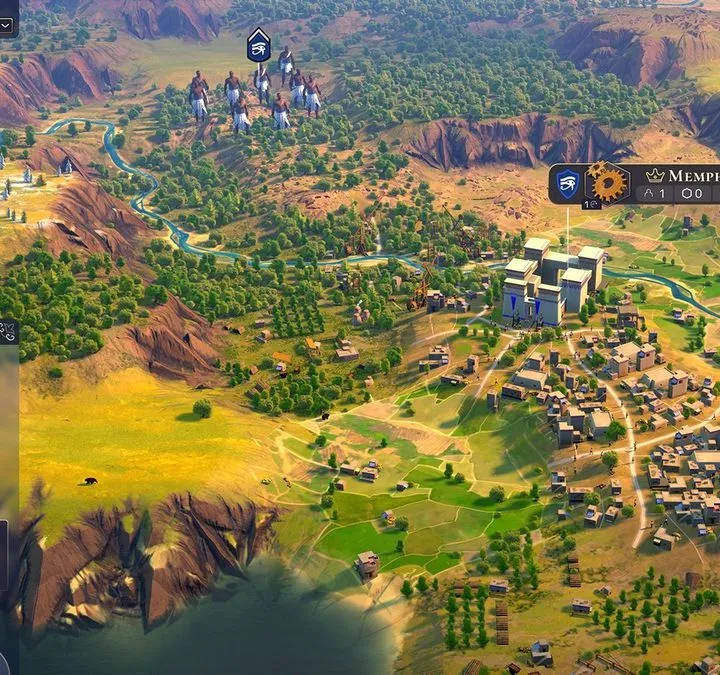
Expand your empire in Humankind during the Colonial Expansion period by managing stability and establishing new cities across the map effectively.
The early game in Humankind is heavily focused on establishing a presence and understanding your surroundings. This involves strategically placing your first Outposts to claim valuable territory and resources, which will form the foundation of your future cities. The initial exploration phase is crucial for identifying good city locations, potential threats, and opportunities for expansion. Understanding the FIMS system (Food, Industry, Money, Science) and how to ass population effectively to these yields is paramount from the very beginning. Early technologies that boost movement speed or provide scouting capabilities can significantly accelerate your ability to explore the map and discover new continents or valuable resource nodes. The game encourages a proactive approach to expansion, as unclaimed territory can quickly be absorbed by rival civilizations. Therefore, a swift and decisive expansion strategy, coupled with careful observation of your neighbors' activities, is key to securing a strong starting position and avoiding early territorial disputes.
When considering where to establish your first Outposts, look for tiles with abundant Food and Industry yields, as these are essential for growing your population and constructing buildings. Proximity to Luxury Resources can also provide significant bonuses. The decision of which culture to choose in the early eras also impacts your expansion capabilities. For instance, certain cultures might offer bonuses to exploration or outpost establishment, allowing you to claim more territory faster. The game's map generation can present various challenges, from vast oceans separating continents to dense forests that hinder movement. Adapting your exploration strategy to the specific terrain and geographical features you encounter is vital. Scouting with initial units, like the Scout unit, is essential to reveal the fog of war and identify potential expansion routes and strategic locations before committing to building an outpost. The early game is a race to claim territory and resources, so efficient movement and intelligent outpost placement are critical for long-term success.
Early Game Expansion Strategies
The initial steps in Humankind revolve around effectively expanding your influence across the map. This begins with the placement of your first Outposts, which serve as the precursors to cities. The goal is to claim valuable territory and resources before your opponents do. Prioritize locations with high Food and Industry yields to support population growth and infrastructure development. Luxury Resources, such as Horses or Spices, are also highly desirable as they provide significant empire-wide bonuses once secured and attached to an outpost or city. The choice of your starting culture plays a significant role in your early expansion. For example, the Nubians offer bonuses to districts built on rivers, making river valleys prime expansion targets. Conversely, cultures like the Sumerians provide early military advantages, allowing for more aggressive territorial claims. Scouting is paramount; utilize your initial Scout units to reveal the fog of war, identify strategic chokepoints, and locate potential city sites. Understanding the terrain is also crucial. Dense forests can slow down movement, while open plains allow for rapid expansion. Adapting your exploration and outpost placement strategy to the specific geographical features of the map is essential for securing a strong foundation for your civilization. The early game is a race against time and your AI opponents, so efficiency in exploration and expansion is key to avoiding being boxed in or losing out on critical resources.
Resource Management and Outpost Placement
The effective management of resources and the strategic placement of Outposts are foundational to success in Humankind. From the Neolithic Era onwards, players must carefully consider where to establish their initial settlements. High Food yields are critical for increasing population, which in turn fuels all aspects of your civilization's growth. Industry yields are necessary for constructing buildings and units, allowing you to develop your infrastructure and military. Money (Coin) is vital for maintaining units and funding various empire-wide actions, while Science is the engine for technological advancement. When scouting, prioritize identifying tiles rich in these core yields. Furthermore, the discovery of Luxury Resources, such as Ivory or Silk, can provide substantial empire-wide bonuses once an Outpost is established and attached to them. The decision of where to place an Outpost should also consider defensive positioning and potential for future city expansion. Building an Outpost near a natural chokepoint or on a defensible hill can provide a strategic advantage. The game mechanics surrounding Outpost attachment mean that securing a cluster of valuable resources with a single Outpost can be highly efficient. Players must balance the immediate need for resources with the long-term strategic value of a location. Early game technologies that enhance movement or provide additional scouting units can greatly assist in this process, allowing for more thorough exploration and informed decisions regarding Outpost placement.
100% Human-Written. AI Fact-Checked. Community Verified. Learn how AntMag verifies content