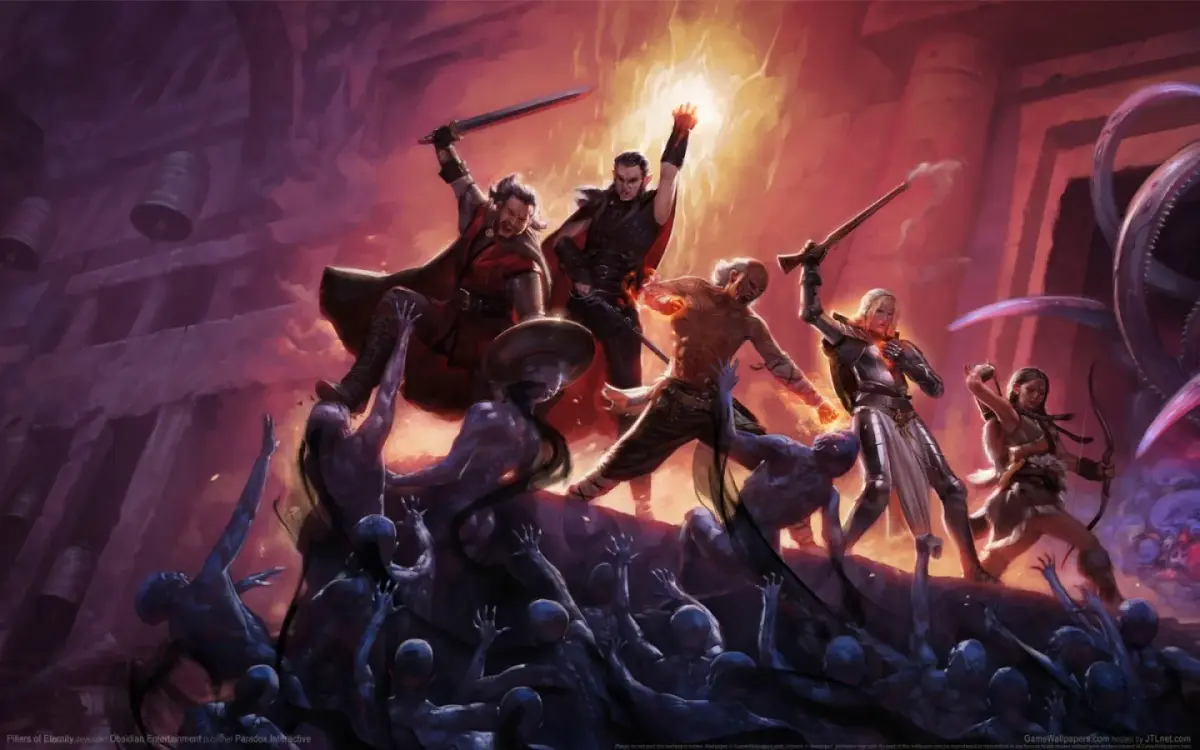
Understand Pillars of Eternity combat mechanics including Move Speed, Attack Speed, Engagement, Attack Resolution, Defences, Damage Reduction, and Interrupts.
Move Speed
Move Speed measures a creature's walking speed, with a nominal value of 4 for normal speed. Bonuses and penalties adjust this base value; for example, the Fast Runner talent grants a +25% boost, while being Blinded halves it.
Attack Speed
Attack speed depends on the weapon's usage time and the character's recovery time between attacks. Ranged weapons may also require reloading.
- Fast Attack/Recovery: Clubs, daggers, fists, flails, hatchets, rapiers, shield bashes, stilettos (0.66s Attack, 1.11s Recovery).
- Average Attack/Recovery: Battleaxes, maces, sabres, spears, swords, warhammers (1.0s Attack, 1.66s Recovery).
- Average Attack/Recovery: Estocs, great swords, morning stars, pikes, pollaxes, quarterstaffs (1.0s Attack, 1.66s Recovery).
- Fast Attack/Recovery: Hunting bows, scepters, wands (1.0s Attack, 1.66s Recovery).
- Average Attack/Recovery: War bows, rods (1.5s Attack, 2.5s Recovery).
- Slow Attack/Recovery: Crossbows (1.5s Attack, 2.5s Recovery, 3.33s Reload).
- Very Slow Attack/Recovery: Arbalests (1.5s Attack, 2.5s Recovery, 6.0s Reload).
- Very Slow Attack/Recovery: Blunderbusses, pistols (1.5s Attack, 2.5s Recovery, 5.0s Reload).
- Slowest Attack/Recovery: Arquebuses (1.5s Attack, 2.5s Recovery, 6.8s Reload).
Wearing armour penalises Recovery Speed.
Casting Speed
Spells have distinct casting and recovery times. An average spell takes just under 3s to cast and just under 2s to recover. Fast spells take around 1s for both, while slow spells take approximately 4s for casting and 4s for recovery. Due to longer casting times than weapon attack speeds, casting spells in melee can be interrupted. Conversely, this provides a window to interrupt enemy casters preparing slow spells.
Engagement
Two characters are engaged if they are using melee weapons, are not moving, and have not reached their engagement limit (default 1, expandable via Talents and Abilities). Moving away from an engaged combatant provokes a disengagement attack. Engagement breaks if a combatant is disabled or engages a different enemy.
Disengagement Attacks
These are free actions that grant the attacker bonuses to Accuracy and Damage.
Attack Resolution
Attack rolls use a d100. The attacker adds their Accuracy and subtracts the target's defence. Results are:
- <= 15: Miss
- 16-50: Graze (-50% damage or duration)
- 51-100: Hit (normal damage or duration)
- > 100: Critical Hit (+50% damage or duration)
Accuracy must exceed defence for a critical hit chance. Penalties and bonuses are additive with other damage modifiers. For example, a sneak attack's +50% damage means a graze deals 100% damage and a critical deals 200% damage. Items or properties can modify results; a _Reliable_ weapon has a 20% chance to promote a graze to a hit, and a _Potion of Merciless Gaze_ has a 15% chance to promote a hit to a critical. Only one promotion can occur per attack.
Primary Attack vs. Full Attack
This distinction matters when dual-wielding. A Primary Attack uses the main-hand weapon, while a Full Attack uses both weapons, applying effects twice.
Defences
- Deflection (DEF): Measures ability to deflect melee and ranged attacks. Base values vary by class (e.g., Fighter 30, Wizard 10), modified by Resolve and shield bonuses.
- Fortitude (FOR): Measures resistance to systemic conditions (poison, disease, knockdowns). Determined by Might and Constitution scores.
- Reflex (REF): Measures ability to evade area-of-effect attacks. Determined by Dexterity and Perception scores.
- Will (WIL): Measures resistance to mental attacks. Determined by Intellect and Resolve scores.
Damage Reduction (DR)
DR subtracts directly from damage. Pale Elves have +10 DR against Freeze and Burn damage, but DR cannot reduce damage below 20% of its original value.
Interrupts
Actions can be interrupted if attacked. The attacker compares d100 + Interrupt score against the target's d100 + Concentration score. A graze subtracts 25 from the attacker's roll, while a critical hit adds 25. If the attacker's roll exceeds the target's, the target's action is interrupted.
100% Human-Written. AI Fact-Checked. Community Verified. Learn how AntMag verifies content