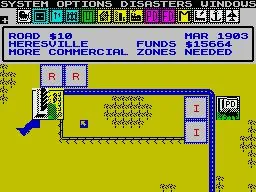
Understand SimCity RCI Meter, Land Value, Pollution, and Population Density. Learn how zones grow, from Residential to Industrial, and their effects.
Walkthrough
- 1Understand Zone Classes: Low (0-29 Land Value), Mid (30-79), Upper (80-149), and High (150-250). Class primarily indicates Land Value and Pollution, with Residential and Commercial Zones needing adjacent High classes to become TOP zones. Industrial Zones randomly pick Low or High classes.
- 2Residential Zones: Start with small houses (20 citizens each). Grow to R-1 (320 citizens) with 8 small houses (160 citizens total), requiring a Population Density of 66 or greater. Further growth leads to R-2, R-3, and R-4 (800 citizens). Two adjacent R-4 High zones can combine into an RTOP (1920 citizens). Growth is affected by the R of the RCI Meter, Land Value, and Pollution. High Land Value can compensate for low demand, while Pollution negatively impacts growth and Land Value.
- 3Commercial Zones: Begin at C-1 (160 citizens) and can grow to C-5 (800 citizens). Adjacent C-5 High zones can form a CTOP (1960 citizens). Maximum size is limited by Land Value (160 needed for TOP), which can be reduced by Pollution. Growth depends on the C of the RCI Meter and a hidden Com Rate stat. Proximity to the city center generally improves growth. Pollution affects class, and combined with Land Value reduction, it's a double penalty. Developed C-Zones retain their rating if power, transportation, and demands are maintained.
- 4Industrial Zones: Grow from I-1 (160 citizens) to I-4 (640 citizens), producing pollution from I-1 onwards. Growth is solely determined by the I of the RCI Meter. Land Value is typically low around Industrial Zones due to pollution. Class is randomly determined upon growth or shrinkage and has no gameplay effect.
Tips
- Keep Residential Zones away from Pollution to maximize growth and Land Value.
- High Land Value can sustain Residential Zone growth even with low demand.
- Commercial Zones can maintain their size even if Land Value drops, provided power, transportation, and demands are met.
- Industrial Zones are easy to grow but can negatively impact surrounding zones due to pollution.
100% Human-Written. AI Fact-Checked. Community Verified. Learn how AntMag verifies content