Elevate your PC Building Simulator 2 skills with advanced benchmarking. Optimize performance, satisfy clients, and secure sponsorships by mastering the 3DMark .
Welcome, aspiring PC building gurus! Beyond simply running 3DMark, mastering advanced benchmarking in PC Building Simulator 2 is crucial for maximizing client satisfaction, tackling complex jobs, and even winning those lucrative eSports sponsorships. This section will guide you through optimizing your testing process for precision and profit.
Understanding Client Benchmarking Requests
Not all benchmarking jobs are created equal. Pay close attention to the specific requirements in the job description. Clients often specify:
- Minimum Score: The most common request. You need to hit or exceed a certain 3DMark score.
- Specific Application: Sometimes clients want a benchmark run on a particular application, like "3DMark Time Spy" or "3DMark Fire Strike." Ensure you select the correct test.
- Target FPS: Less common for benchmarking, but some repair jobs might ask you to ensure a game runs at a certain FPS. This requires installing the game and monitoring performance.
- Overclocking Requirement: For advanced jobs, clients might explicitly ask for an overclocked system to achieve the benchmark goal.
Optimizing Your Test Bench
A clean, efficient test bench is key to reliable results. Before running any benchmark, always ensure:
- Clean OS Installation: For critical benchmarks, especially those involving overclocking, consider a fresh OS install. Navigate to the "Operating System" app on your in-game tablet, select "Reinstall OS," and choose "Fresh Install." This eliminates background processes that could skew scores.
- Latest Drivers: Always update graphics drivers. Use the "Drivers" app on your tablet. Outdated drivers can significantly impact performance.
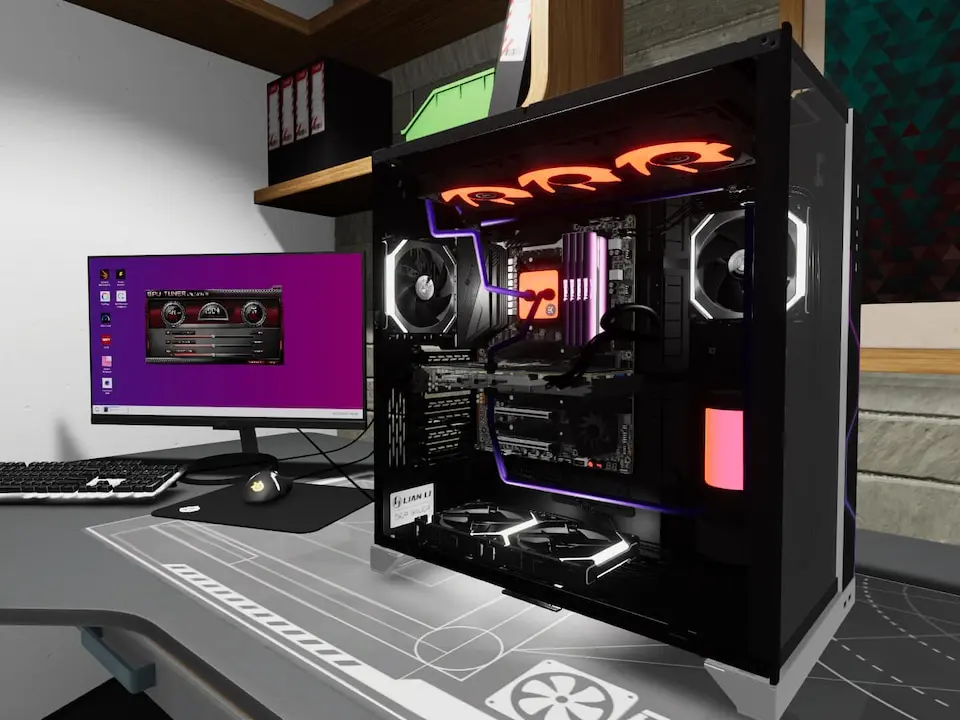
- Proper Cooling: Overheating components will throttle performance and lower benchmark scores. Ensure your CPU and GPU have adequate cooling. For high-end builds, consider custom water cooling loops for optimal thermal management. Check temperatures using the "Monitoring" app during the benchmark.
- Power Delivery: A stable power supply is vital. Ensure your PSU has sufficient wattage for all components, especially when overclocking.
Strategic Overclocking for Benchmarks
Overclocking is your most powerful tool for hitting those high benchmark scores. However, it requires careful management.
CPU Overclocking
- Access BIOS: Restart the PC and repeatedly press the "DEL" key (or the key indicated on the boot screen) to enter the BIOS.
- Navigate to Overclocking Settings: Look for sections like "OC Tweaker," "Extreme Tweaker," or similar.
- Adjust Core Ratio: Incrementally increase the "CPU Core Ratio" (multiplier). Start with small steps (e.g., +1 or +2).
- Adjust Vcore (CPU Voltage): As you increase the core ratio, you'll likely need to increase "CPU Core Voltage" (Vcore) to maintain stability. Again, use small increments (e.g., +0.01V).
- Monitor Temperatures: After each adjustment, save and exit BIOS, boot into the OS, and run a quick benchmark (or a stress test like Prime95 if available in-game) while monitoring temperatures with the "Monitoring" app. Aim to keep CPU temps below 80-85°C under load.
- Repeat and Refine: Continue this process until you hit your target score or reach thermal/stability limits.
GPU Overclocking
- Install Overclocking Software: Use the "Install Programs" app on your tablet and install "GPU Tuner" (or similar GPU overclocking utility).
- Adjust Core Clock: Incrementally increase the "Core Clock" slider.
- Adjust Memory Clock: Incrementally increase the "Memory Clock" slider.
- Adjust Power Limit: Increase the "Power Limit" slider to allow the GPU to draw more power, which can aid stability and higher clocks.
- Monitor Temperatures: Run 3DMark after each adjustment and monitor GPU temperatures using the "Monitoring" app. Aim to keep GPU temps below 75-80°C under load.
- Repeat and Refine: Continue until you achieve the desired benchmark score or encounter instability/thermal issues.
Pro Tip: For extreme benchmarks, consider using high-end thermal paste like "Thermal Grizzly Kryonaut" from the "Shop" app to squeeze out those extra few degrees of cooling performance.
Advanced 3DMark Usage
The 3DMark application itself offers more than just a "Run Benchmark" button.
- Select Specific Tests: For jobs requiring "3DMark Time Spy" or "3DMark Fire Strike," ensure you select the correct test suite from the main 3DMark menu before running.
- Looping Benchmarks: While not directly useful for job completion, running benchmarks in a loop (if the option is available in-game) can help identify long-term stability issues after overclocking.
- Score Comparison: After a benchmark run, the results screen allows you to compare your score against similar systems or global averages. This is useful for gauging your build's performance relative to others.
Troubleshooting Low Scores
If your benchmark scores are consistently lower than expected, consider these troubleshooting steps:
- Check Component Compatibility: Ensure all components are compatible. An incompatible CPU/motherboard or RAM can severely bottleneck performance.
- RAM Speed and Configuration: Verify RAM is installed in the correct dual-channel (or quad-channel) slots as per the motherboard manual (accessible via the "Manuals" app). Also, ensure the XMP profile is enabled in BIOS to run RAM at its advertised speed.
- Power Cables: Double-check all power cables are securely connected, especially the 24-pin ATX, 8-pin CPU, and PCIe power connectors for the GPU.
- Thermal Throttling: As mentioned, high temperatures will cause components to slow down. Re-apply thermal paste, ensure fans are spinning, and consider better cooling solutions.
- Faulty Components: In rare cases, a component might be faulty. Use the "PC Info" app to check component health or swap out suspected parts.
By implementing these advanced benchmarking strategies, you'll not only meet client demands with ease but also gain a deeper understanding of PC performance optimization, making you a true master of PC Building Simulator 2.
100% Human-Written. AI Fact-Checked. Community Verified. Learn how AntMag verifies content