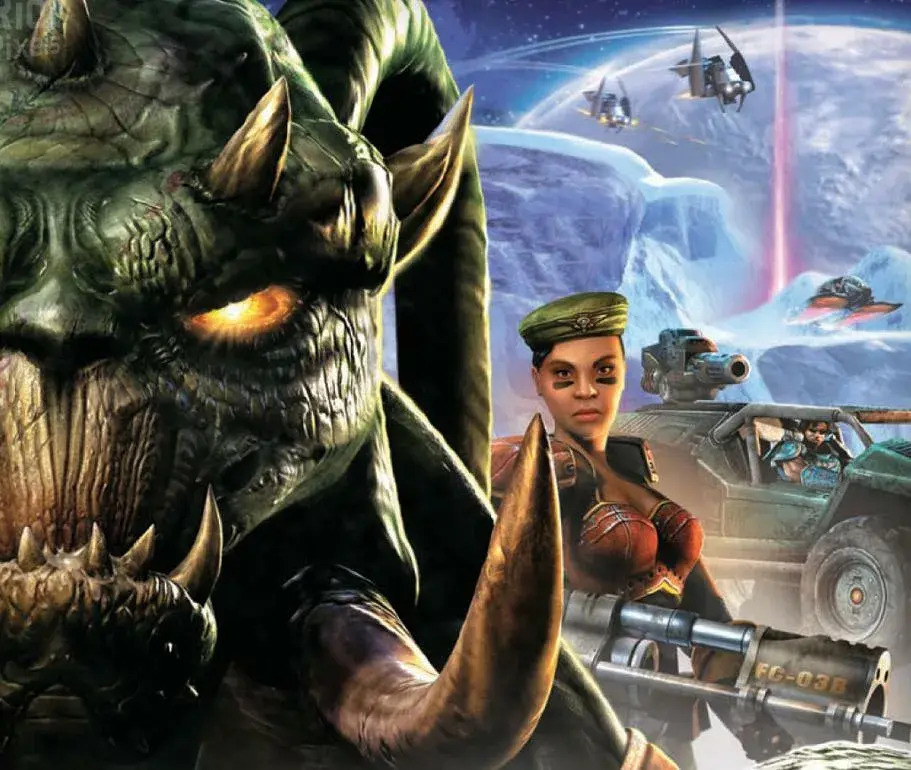
Welcome to the arenas of Unreal Tournament 2004, a fast-paced arena shooter where skill, reflexes, and weapon mastery are key to survival. Whether you're diving into the chaotic Deathmatch, coordinating with your team in Capture the Flag, or piloting powerful vehicles in Onslaught, UT2004 offers intense, high-octane combat across a variety of game modes.
This guide is your comprehensive companion to dominating the battlefield. We'll break down everything from essential movement techniques and weapon strategies to understanding the nuances of each game mode, including Assault and Double Domination. Learn how to chain Adrenaline Combos, effectively utilize every pickup, and even face off against the legendary Xan Kriegor.
Part 1
Dive into Unreal Tournament 2004 with our Part 1 guide. Learn the core concepts, basic controls, and essential strategies to dominate the arena. Get started now!
Alright, so you've just booted up Unreal Tournament 2004 and you're wondering what all the fuss is about. This first part of the guide is all about getting you into the right headspace. Forget realism; this game is pure, unadulterated, fast-paced FPS action. Think crazy weapons, insane movement, and maps that are more like obstacle courses than actual buildings.
The core idea behind Unreal, and especially the Tournament series, is to throw you into the action and let you loose. You're not some soldier trying to survive a gritty war; you're an athlete in a high-octane combat sport. So, ditch the idea of cover and careful ammo conservation. Here, it's all about speed, agility, and overwhelming firepower. You'll be running, jumping, wall-jumping, and firing non-stop. Don't get too attached to your character – you'll die, respawn, and get right back into the fray. It's a cycle of intense combat, and the faster you embrace it, the better you'll do.
When it comes to the 'Tournament' part of the name, things shift a bit towards multiplayer and teamwork. While you're still going to be pulling off insane moves and firing ridiculous weapons, you'll often be doing it as part of a team. Cooperation and coordination are huge here. Learn to play with your squad, listen to callouts, and work towards the objective. Some players get frustrated when things don't go their way and just run off doing their own thing, but that's a surefire way to lose. Stick with your team, communicate, and you'll find a lot more success and a lot more fun.
Part 2
Dive into the lore and history of Unreal Tournament 2004. Understand the plot, the evolution of the series, and what makes UT2004 a standout.
Alright, so you've jumped into the arena and maybe gotten a little roughed up. That's totally normal! The key here is to keep your cool, keep an eye on what you're supposed to be doing, and try not to respawn *too* often. While there are plenty of ways to play solo, if you're just starting out, stick to Team Deathmatch for now.
The Big Picture: What's New in UT2004?
Unreal Tournament 2004 really steps things up. The biggest addition is the Onslaught game mode, which brings vehicles into the mix. Unlike previous games, teamwork in UT2004 is absolutely crucial. You *have* to work as a coordinated unit, or you'll face a seriously embarrassing defeat. Going it alone just won't cut it, even if you think you're helping the team. The game demands more discipline, more selflessness, and a sharper focus if you're aiming to win. Of course, if you're just here to mess around and have a blast, go for it – just don't expect your teammates to be thrilled.
A Quick Look Back: The UT Story So Far
This section gives you a rundown of what you're doing in the single-player campaign and a quick recap of the major events in the tournament's history. We'll also touch on the earlier Unreal games and how they've evolved into what you see today. We're skipping Unreal 2 and its expansion pack because, honestly, they don't really add much to UT2004.
The Plot of UT2004: Why Are We Fighting?
Way back when, humans and the Skaarj were locked in a brutal war that messed up their whole galactic empire. To help calm down the riled-up colonists and get things back on track, the Liandri Corporation cooked up the idea of a gladiatorial tournament for miners. It got so popular it turned into a massive sport, with sponsored teams duking it out in custom-built arenas. For ages, a robot named Xan Kreigor was the undisputed champ. That is, until Malcolm, leading the Thunder Crash team, took him down. Malcolm then merged his team with the popular Iron Guard, led by Brock. Last year, though, they were both beaten by the Juggernauts, a team led by the genetically enhanced monster, Gorge. Now, as the tournament hits its 10th year, Malcolm's back with Thunder Crash to reclaim his title, Brock's with Iron Guard aiming for glory, and Gorge and the Juggernauts are ready to defend their championship. To top it off, the Skaarj Empire has even sent their own team to compete for honor and glory. Oh, and Xan Kreigor, the former champ, has had some serious upgrades and is back to take the title home. There are other side-plots, but these are the main players. And you? You're entering the tournament to throw your hat in the ring!
Unreal Through the Years: The Evolution
It all started a long time ago with the original Unreal, created by Epic. It packed a ton of innovative features for the FPS genre, including bot matches, and basically set the standard for what was to come. It also built a rich, sci-fi universe where humanity had become a space-faring civilization. Since then, various companies have built on that success, consistently releasing games that are familiar yet significantly better. The original game featured a unique arsenal: a forked chargeable pistol, an automatic pistol, an assault rifle, the Gloop Gun, the legendary Razor Jack, a minigun, a sniper rifle, and the Eight-Ball, among others I can't quite recall.
The original Unreal offered players something truly new. An expansion pack was released, developed by Legend Entertainment Company, though I didn't get a chance to play it.
Then came Unreal Tournament from Digital Extremes. This was, as far as I know, the first game primarily designed for multiplayer. It boasted a massive graphical upgrade, but more importantly, it revolutionized gameplay. While other games might have had Capture The Flag, UT took it to an entirely new level with beautifully crafted and meticulously designed maps. This is where the 'team player' truly emerged. Suddenly, playing as a cohesive unit became just as vital as individual skill, allowing smarter, perhaps less mechanically gifted, players to band together and overcome opponents. It marked a new era in FPS gaming, at least for me. The infinite chargeable pistol was swapped out for the Impact Hammer melee weapon, the automatic pistol became the Enforcer, the assault rifle was removed, the minigun was redesigned, the Razor Jack was renamed the Ripper and also redesigned, and the Eight-Ball was rebranded as the Rocket Launcher. The rest were mostly remodels.
Next up was Unreal Tournament 2003, again by Digital Extremes. It was essentially the same as the original UT, but with vastly superior graphics. It was a great way to update a classic, and I was grateful for it. It also introduced some really cool new elements: the double-jump and adrenaline. In my opinion, the double-jump was a game-changer for firefights in any FPS. Adrenaline was another innovative addition that really boosted team play when used effectively – imagine catching that flag-thief who just activated a speed boost! The weapons were largely the same as in the original UT but redesigned, with a few exceptions: the Impact Hammer became the Shield Gun, the Enforcer transformed into the Assault Rifle, and the Ion Painter was a brand-new addition. They also removed the Assault Game Mode.
Finally, not too long ago, Unreal Tournament 2004 was released by Epic Games. To everyone's surprise, it was...
Part 3
Learn essential movement techniques in Unreal Tournament 2004, from basic running and jumping to advanced dodge-jumps, to dominate the battlefield. Master every move!
Alright, let's dive into the nitty-gritty of moving around in Unreal Tournament 2004. This section is all about getting you comfortable with the controls so you can zip around the map like a pro, whether you're dodging rockets or making a quick getaway. We'll cover the basics and then get into some more advanced stuff that'll really make you stand out.
Basic Movement:
- Running: This is your bread and butter. You'll be doing this constantly. Remember, a moving target is way harder to hit. Strafing is essential, but don't be predictable – mix up your directions. There's no dedicated 'walk' button, so you're always ready to move.
- Jumping: Honestly, a single jump isn't super useful. It's too slow and predictable. Only use it if you're about to bump your head or get snagged on something. It can sometimes help with wall-jumps, but don't rely on it. Always try to chain it into a double-jump if you can.
- Double-Jump: Now we're talking! This is a crucial maneuver. Chain your normal jump into a double-jump whenever you have the space. The trick is to hit the second jump *before* you start falling, or it won't register. It's great for reaching high spots, but its real power is in combat. Being airborne makes you a much tougher target, and it can even help you aim rockets better against the ground. Just be aware that it doesn't move you horizontally very fast, so skilled players can still predict your landing spot.
- Crouching: Don't underestimate crouching! While everyone's focused on moving, crouching is perfect for holding down a defensive position. It's ideal for sniping from behind cover or hiding on ledges. The main goal is to keep your torso hidden, as that's a prime target for snipers. Crouching also lets you look through floor grates to see what's below, and it prevents you from accidentally falling off ledges while you're lining up a shot.
- Driving: Seriously, learn to drive! Use the forward and backward directional buttons for throttle and brake/reverse, and left/right for steering. The mouse controls your camera and weapons. Some vehicles have a handbrake or jump function mapped to the Jump key. Always know where you're going, keep your eyes on the road unless absolutely necessary, try not to run over your teammates, and approach teammates you see – they might need a ride!
Advanced Movement:
- Dodging: This is in 'Advanced' because you should RARELY use it. It's slow, short, and has a long cooldown. You're almost always better off using a Dodge-Jump. The only time it might be useful is in super tight spaces, like a narrow platform with instant death on either side, or in low gravity where a Dodge-Jump would send you flying too far. Generally, just avoid it. Also, don't try to dodge uphill or up stairs – it just doesn't work.
- Dodge-Jump: This is where it's at! It's everything the regular Dodge wishes it could be. It's faster, goes further, and is actually useful for getting around quickly. Use it for general travel, unless you're going uphill, up stairs, or need to make a really sharp turn.
Part 4
Master Dodge-Jumping and Wall-Jumping in Unreal Tournament 2004. Learn advanced gunfire techniques like leading targets and utilizing weapon firing modes.
Dodge-Jump Techniques:
- The Dodge-Jump shares the same recharge time as the simple dodge, so time your dodges carefully.
- Dodge-Jumping to the side can help you evade most splash damage (except possibly the Shock Combo), making you a harder target to track and hit.
- Dodge-Jumping forward, into enemy fire, can be effective against rocket launchers. The enemy may aim at your feet, allowing you to fly over the projectile and close the distance.
- Dodge-Jumping backwards is useful for escaping while firing covering fire, especially when carrying the flag.
- Warning: Be mindful of your surroundings when Dodge-Jumping; avoid corners, jagged geometry, or traps, and do not perform them consecutively due to recharge time.
Wall-Jump Techniques:
- To perform a Wall-Jump, while airborne and near a wall, double-tap the directional button away from it.
- This move is especially useful after a double jump and can prevent you from landing on rockets or bombs.
- Wall-Jumping covers ground quickly, extends your double jump, and can place you in unexpected positions.
- Warning: Avoid Wall-Jumping in cramped spaces, as you may slam into the opposite wall and become momentarily stuck. It is also not recommended near traps or with low or jagged ceilings, as you cannot aim effectively.
Basic Gunfire:
- Firing Modes: All weapons in Unreal Tournament 2004 have two firing modes: Primary and Secondary. These can be configured in the options menu. Each mode can have different uses, and it's important to learn their specific functions.
- Aiming: Practice your marksmanship while moving. Crouching does not improve aim, and running does not significantly hinder it. When in vehicles, learn to fire while moving, utilizing jumps and strafes if available, to become a harder target.
- Inventory: The HUD (Heads-Up Display) may not show all 16 weapons, as some occupy the same slot. Pay attention to weapon slot indicators and remember which weapons you have equipped, especially for weapons like the AVRiL which shares a slot with the Rocket Launcher.
- Self-Injury: Be cautious of splash damage from weapons and ricocheting shrapnel from the Flak Cannon, especially when performing Double-Jumps and Dodge-Jumps, to avoid injuring yourself.
Advanced Gunfire:
- Leading Your Target: For most projectile weapons, you must aim where you anticipate the enemy will be when the projectile hits, not where they are currently. This is crucial when enemies are running, jumping, or in vehicles. For airborne enemies, aim where they are expected to land. If an enemy is Dodge-Jumping, try to track them and shoot when they land.
- Sniping: Even with instant-hit sniper rifles, leading your target is beneficial due to the time it takes to process the shot and for the enemy to react.
Similar guides you might like
100% Human-Written. AI Fact-Checked. Community Verified. Learn how AntMag verifies content