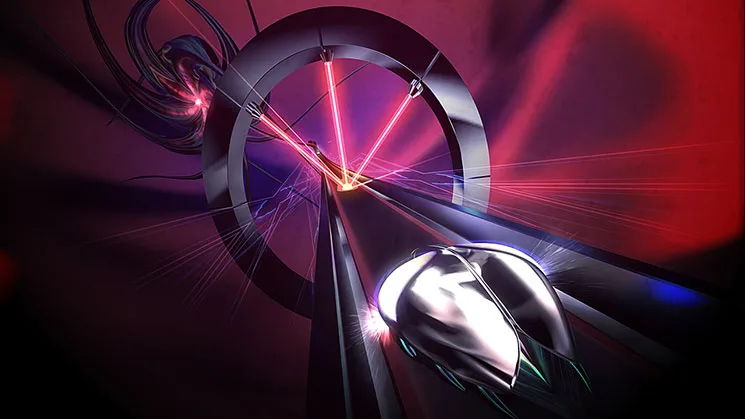
Master Thumper's rhythm violence gameplay and beat system. Learn to integrate precise timing, tactile feedback, and auditory cues for survival and high scores.
Thumper is a rhythm violence game, and mastering its unique rhythm system is paramount to survival and achieving high scores. Unlike traditional rhythm games that often rely on visual cues alone, Thumper integrates tactile feedback and auditory precision into its core gameplay. Think of your beetle as an instrument, and the track as its score.
The Core Beat: Pulse and Action
At its heart, Thumper operates on a consistent, underlying pulse. This pulse is your primary guide. While the visual track will present obstacles and turns, every action you take – whether it's a turn, a slam, or a spike attack – is tied directly to this beat.
- The Pulse: Listen carefully. There's a subtle, rhythmic throb that permeates every level. This is your internal metronome. Try to feel it in your hands as you play.
- Action Cues: Every actionable event on the track will have a distinct auditory cue that aligns with the pulse. For instance, a sharp "thwack" often precedes a turn, while a deeper "thump" might indicate a slam opportunity.
- Visual Reinforcement: While sound is key, the track itself provides visual cues. The glowing segments of the track, the approaching obstacles, and the timing of the turns are all synchronized with the beat. Pay attention to how the track lights up and pulses in time with the music.
Mastering the Turns: Precision and Anticipation
Turns are your most frequent interaction and a critical component of maintaining your rhythm. Missing a turn breaks your combo and can lead to damage.
- Timing is Everything: You must press the action button (typically 'X' on PlayStation, 'A' on Xbox/Switch, or Spacebar on PC) precisely as you enter the turn segment. Pressing too early or too late will result in a "Bad" rating and a loss of momentum.
- Auditory Cue: Listen for the distinct, sharp "click" or "thwack" sound that signals the exact moment to execute the turn. This sound is your most reliable indicator.
- Visual Cue: The track will visibly narrow and glow intensely at the apex of a turn. Use this as a secondary visual aid, but prioritize the auditory cue for perfect timing.
- Anticipation: As you progress, turns will become more frequent and complex, often appearing in rapid succession. Learn to anticipate these sequences by observing the track ahead and listening for the repeating auditory patterns.
Slamming Through Obstacles: Power and Rhythm
Slamming is your primary offensive maneuver, used to destroy obstacles and collect valuable "Beats" (the glowing energy orbs).
- The Slam Action: To perform a slam, you'll typically hold down the action button and then release it at the precise moment you hit the obstacle.
- Auditory Cue: A deeper, more resonant "thump" or "boom" sound will indicate the optimal moment to release the button for a perfect slam.
- Visual Cue: Obstacles that can be slammed will often glow with a distinct energy, and the track leading up to them will pulse in anticipation.
- Perfect Slams: Achieving a "Perfect" slam not only destroys the obstacle but also grants you bonus points and contributes significantly to your combo multiplier. A "Perfect" slam is characterized by a satisfying, powerful sound and a larger explosion.
Spike Attacks and Grind Rails: Advanced Rhythmic Interactions
Later levels introduce more complex rhythmic elements like spike attacks and grind rails, demanding even greater precision.
- Spike Attacks: These require a quick, timed press of the action button to deflect incoming spikes. The timing is often a rapid, single beat. Listen for a sharp, almost metallic "ping" sound.
- Grind Rails: These segments require you to hold the action button for the duration of the rail. Releasing too early or too late will break your combo. The auditory cue here is a sustained "hiss" or "grind" sound, which ends abruptly when the rail does.
- Combining Actions: As you advance, you'll encounter sequences that combine turns, slams, and spike attacks in rapid succession. The key here is to internalize the distinct auditory cues for each action and react instinctively to the rhythm.
The Importance of Headphones
While Thumper is playable without them, using high-quality headphones is highly recommended. The intricate sound design provides crucial auditory cues that are often subtle but essential for achieving "Perfect" ratings and maintaining your combo. Headphones allow you to fully immerse yourself in the game's oppressive atmosphere and, more importantly, to discern the precise timing of every rhythmic interaction.
100% Human-Written. AI Fact-Checked. Community Verified. Learn how AntMag verifies content