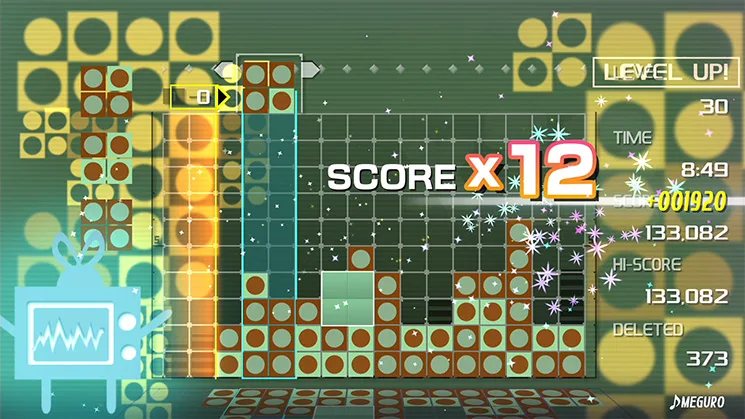
Learn advanced block strategies for Lumines Remastered, including Slicing, Double Slicing, and Deuce manipulation, to maximize your score and clear blocks efficiently.
Hey there! Ready to take your Lumines Remastered game to the next level? High scores in this game aren't just about luck; they're about smart play. You'll want to mix and match a few different block strategies at the same time. It's a dynamic dance, keeping an eye on everything as the blocks fall!
Let's break down some of the cooler ways to clear blocks, especially those tricky Oneys and Treys.
A. Special Strategies for Oneys and Treys
Oneys and Treys are the same block shape, just flipped. They can be a pain, but there are some neat tricks to get rid of them efficiently.
1). Slicing
This is all about precision. Look for a single block of the same color that's sitting next to or near a lone square of a different color within an Oney or Trey. Your goal is to position the Oney/Trey so that the single, off-colored square is directly above the matching single block. This works whether the single block is all by itself or part of a longer line of blocks.
Imagine you have a single block of color A, and next to it, a 2x2 block of color B. If you get an Oney or Trey that's mostly color B with one square of color A, you can place it so the color A square lands right on top of the lone color A block. This clears out the color B part of the Oney/Trey and leaves you with just the single color A block, which is much easier to deal with.
2) Double Slicing
This is similar to regular slicing, but you're using blocks that are two squares high. The idea is the same: line up an off-colored square on your falling block with a matching single block on the board. You can position the falling block so the off-colored square is either on top or on the bottom, depending on what fits best with the blocks already on the screen. Remember, 'pairs good' – always scan the board and think before you drop!
3) Build with the Blocks Themselves
Sometimes you won't have the perfect single blocks to slice with. In these cases, you can actually build specific shapes using the Oneys and Treys themselves. Aim to create patterns that look like two separate 2x2 blocks, each with a single different-colored square attached to one side. These specific shapes can then be cleared in two passes of the timeline, leaving you with a clean board.
B. Strategies for Deuces
Deuces (the 2x2 blocks) can be a bit trickier because they're often the building blocks of the dreaded checkerboard pattern that you want to avoid. Instead of letting them create chaos, try to build specific patterns with them.
One effective way is to create shapes that look like two separate 2x2 blocks, but with a gap in the middle. These patterns can be cleared out over two timeline passes, leaving you with two vertical columns of blocks. You can then clear those columns with another two timeline passes.
Another Technique for Deuces
Here's a more advanced technique: dedicate a five-square-wide area on the right side of your grid specifically for dealing with Deuces. Why the right side? So you can keep a close eye on the timeline, which is super important for this strategy. One square in this area is left blank to act as a separator.
On the main part of the grid, just play normally, clearing out blocks and managing leftovers. But in your special Deuce zone, you'll build a specific pattern using only Deuces. This pattern, when cleared over two timeline passes, creates a specific gap. You then use the next Deuce that falls to fill that gap, which clears out more blocks and sets up the next stage. You keep dropping Deuces into the created spaces, clearing them out efficiently and preventing that nasty checkerboard pattern from forming.
It sounds complicated, but once you get the hang of it, you'll be clearing Deuces like a pro!
100% Human-Written. AI Fact-Checked. Community Verified. Learn how AntMag verifies content