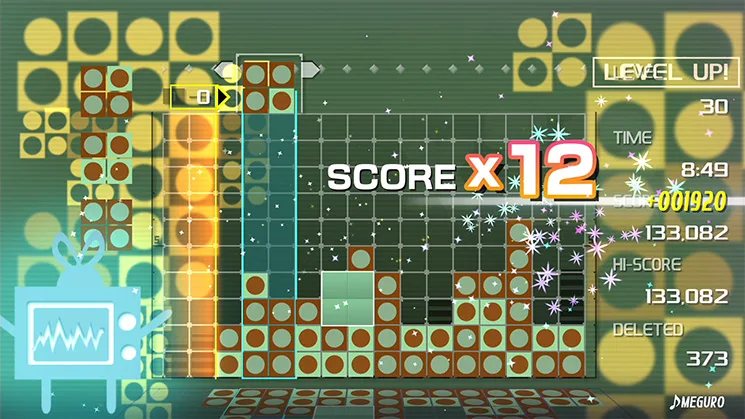
Learn the fundamentals of Lumines Remastered's block system! Understand the 6 basic block types and how their rotations create 16 unique block combinations.
Hey there! Welcome to Lumines Remastered. Let's dive into the absolute core of the game: the blocks themselves. It might seem simple at first, but understanding how these little guys work is key to mastering the game.
At its heart, Lumines Remastered is all about six basic block shapes. You've got your 'blankey', 'oney', 'twoey', 'deuce', 'trey', and 'quad'. But here's the cool part: when you rotate these blocks, they can actually form different unique shapes. So, while there are only five original block types, their rotations mean you're dealing with more unique block configurations than you might think!
- Blankey: This one's straightforward. It doesn't change its shape when you rotate it. So, it's just 1 unique block.
- Oney: This block shape can be rotated four different ways, giving you 4 unique block variations.
- Twoey: Similar to the oney, the twoey also has four distinct orientations when rotated, resulting in 4 unique blocks.
- Deuce: The deuce is a bit simpler in its rotations, offering 2 unique block shapes.
- Trey: This block shape can be rotated into four different configurations, giving you 4 unique blocks.
- Quad: Like the blankey, the quad doesn't change its appearance no matter how you spin it. It's just 1 unique block.
So, when you add up all the possible rotations, those five original blocks actually give you a total of 16 unique block combinations. It's a neat little system that makes the puzzle aspect of Lumines so engaging!
It turns out there's a bit of math behind this! If you think about a block made of four squares, and you consider all the possible ways those squares can be arranged, you get 16 combinations. It's like 4 squared (4x4), which equals 16. Pretty neat, huh?
Someone pointed out a more precise mathematical reason: each square within a block can be one of two colors, and since there are four squares per block, it's actually 2 to the power of 4 (2^4), which also equals 16. Thanks for that insight!
100% Human-Written. AI Fact-Checked. Community Verified. Learn how AntMag verifies content