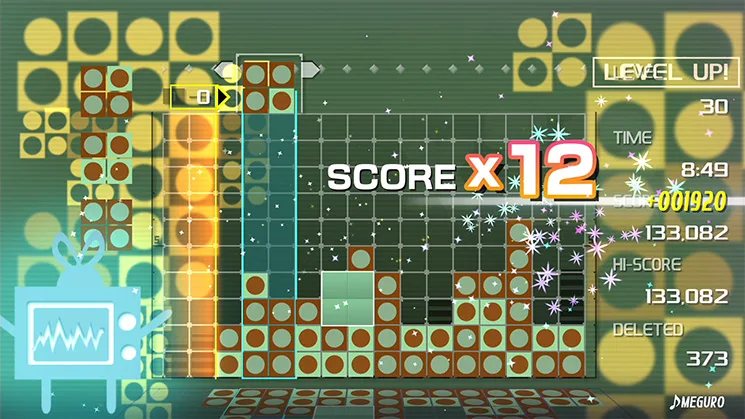
Learn essential Lumines Remastered block placement strategies, including avoiding checkerboard patterns and utilizing pairs for longer survival and higher scores.
Think leftovers...
Before we talk about the main focus of this game--making rectangles of like-colored blocks--let's first consider something much more important to your long-term survival in Lumines...
What's left behind when you make those wonderful like-colored blocks?
Consider the following. It happens to be a very good technique in its own right -- the best for getting rid of a leftover "nub" (one square sticking up with nothing surrounding it). It, in fact, makes you a "delete" and gets you pointage.
But it also leaves something behind, which many (but not all) dropped blocks will do.
Trey deletes nub
You get the delete, and the pointage that goes with it, but you're left with another nub. Of course,if you drop a contrasting trey on it you get another delete, and the pointage that goes with _it._ But you're left with another nub, and...well, you get the idea.
In fact, it's not a bad strategy to park a nub out somewhere that you can use to get rid of treys, if that's your style. But we're getting ahead of things here.
The main point to be learned here is that a lot of the time, dropping blocks may get you deletes, which in turn gets you points. But the act of dropping also leaves squares behind. It's how you manage those squares left behind--both in terms of how you make them, and how you endeavor to get rid of them--that will dictate your long-term survival, and, ergo, how high your score gets, and how many of those precious skins you unlock.
So, here's two points worth remembering:
- A. Deleting blocks gets you points; and,
- B. Managing leftover blocks lets you survive longer
To have ying, you must have yang. And that's the true balance of this game.
Concentrate just on making blocks to delete, and you'll not last long. And if you concentrate just on leaving good stuff behind, you won't as high a score.
But do both... ah, now that is the beauty.
Ahem. Where was I? Oh, right. This brings me to the the cardinal rules of Lumines...
Rule No. 1: Checkerboard bad
Repeat after me: "Checkerboard bad."
This is your new mantra. What this means is that anytime you make deletes that produce a pattern like this...
...or the vertical equivalent that looks like this...
You will have a difficult time getting rid of those blocks. Why? Since only rectangles of like-colored blocks can be deleted, you cannot add anything to this pattern from above that creates a delete.
Strange but, as my kid says, "oddly true."
At best, you can only start over using the top of this row as the new "floor." Bummer is you're that much closer to the top of the grid, and, ergo, the end of the game.
If you've been unfortunate enough to create this pattern, your only hope to delete part of it is to get a destroyer bock. Use a destroyer and create a square on top of this pattern, and you'll be lucky enough to create a one-square chink in it, which you could theoretically use to start the laborious work of slowly getting rid of the whole "new floor."
If you're super-good, you could build an elaborate chain connected to the destroyer (something covered later in this FAQ) to delete more than one like-colored square. But that's a lot of work. Better to not get yourself in this position in the first place.
Luckily, there is a corollary to "checkerboard bad," and it is:
Rule No. 2: Pairs good
Repeat after me: "Pairs good." This is your new complementary mantra.
Ideally, as you create deletes, you want to be creating a pattern that looks like this..
...or the vertical equivalent that looks like this...
These are better, because you could drop a twoey that looks like this...
...or even a trey or oney that looks like this...
... or even a blankey or quad that looks like this...
100% Human-Written. AI Fact-Checked. Community Verified. Learn how AntMag verifies content