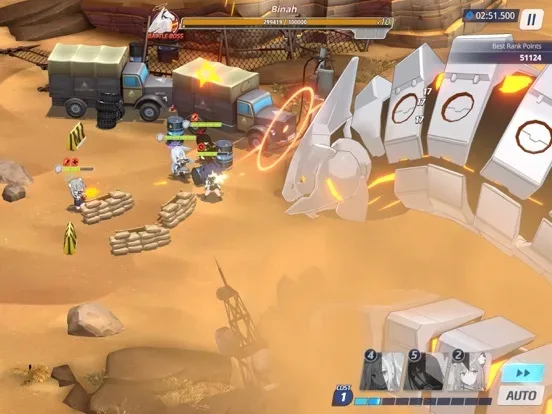
Kivotos's narrative continues to unfold with new main story chapters and engaging limited-time events, offering unique challenges and valuable rewards. These are central to Blue Archive's ongoing content cycle.
Main Story Update: Vol. 2, Chapter 3 "The Rabbit of Caer Bannog" (Example)
Major updates frequently advance the main storyline, delving deeper into the mysteries and conflicts of Kivotos. These chapters often come with new battle stages and challenging boss encounters, expanding the world and its lore.
- Access: Navigate to the "Story" tab from the main menu and select "Main Story." Then, choose the relevant Volume and Chapter to begin.
- Key Plot Points (Example from "The Rabbit of Caer Bannog"):
- Following the dramatic events of Chapter 2, Sensei and the students of SRT Special Academy (Miyako, Saki, Miyu, Kirino) find themselves embroiled in a desperate conflict.
- The narrative focuses on the SRT students' struggle for survival and their determination to uphold their ideals amidst the political machinations of Kivotos.
- New insights are gained into the history and purpose of the SRT Special Academy, and the motivations of its students are further explored.
- The story culminates in a major confrontation that tests the bonds and resolve of the Rabbit Platoon.
Note: The specific plot points will vary with each new main story chapter released.
- Rewards: Completing main story stages rewards Pyroxene (20 per stage for first clear), Credits, and various enhancement materials. Hard mode stages (unlocked after clearing normal mode) offer character Elephs for specific students, making them crucial for character progression. These Elephs are often for students relevant to the chapter's story.
- Strategy Tips for Main Story Stages:
- Recommended Combat Power (CP): Always check the recommended CP for each stage. If your team's CP is significantly lower, consider leveling up students, upgrading skills, or enhancing equipment. A difference of 10,000-20,000 CP can be manageable with good strategy, but larger gaps often require more power.
- Elemental Advantage: Utilize the elemental triangle: Explosive attacks are strong against Light Armor, Piercing attacks against Heavy Armor, and Mystic attacks against Special Armor. Match your main damage dealers to the enemy armor types. For example, if facing Light Armored enemies, bring Explosive Strikers like Aru or Hoshino.
- Cover Mechanics: Position your students behind cover to reduce incoming damage. Tanks and Strikers with high DEF benefit greatly from cover. Students like Haruna or Iori can ignore cover with their EX Skills, which is useful against entrenched enemies.
- EX Skill Timing: Learn when to best use your students' EX Skills. For example, save powerful damage skills for elite enemies or bosses, and use healing/buffs proactively before major damage phases. Chain EX Skills for maximum effect (e.g., a DEF debuff followed by a powerful attack).
- Team Composition: A balanced team typically includes 1-2 Tanks, 2-3 Damage Dealers, and 1-2 Supporters/Healers. Adjust based on stage requirements. Some stages might require more crowd control, while others demand burst damage.
- Retreat and Re-strategize: Don't be afraid to retreat if a stage is going poorly. Analyze enemy types, attack patterns, and your team's weaknesses, then adjust your student lineup or skill usage.
Limited-Time Event: "Bunny Chaser on Board" (Example)
Limited-time events are a cornerstone of Blue Archive, providing unique stories, exclusive rewards, and often new gameplay mechanics. These events are crucial for acquiring valuable resources and sometimes even free students or their Elephs.
- Access: Events are accessible from the "Events" tab on the main menu during their active period. Always check the event duration to ensure you complete all objectives and clear the event shop.
- Event Structure: Most events follow a similar structure:
- Story Stages: Progress through a unique event story, often featuring specific students. These stages reward event currency upon first clear and subsequent clears. They typically have varying difficulty levels.
- Challenge Stages: Higher difficulty stages that test your team's strength, offering bonus event currency or unique rewards (like Pyroxene) upon first clear. These are typically one-time clears and do not consume AP after the first clear.
- Raid/Co-op Boss (if applicable): Some events feature a special boss that You can challenge multiple times daily for significant event currency. These bosses often have specific weaknesses and mechanics.
- Event Shop: Exchange accumulated event currency for valuable items like skill materials, character Elephs, recruitment tickets, and exclusive furniture. This is the primary reward hub for events.
- Featured Students/Bonus: Events often feature specific students who, when included in your team, provide a bonus to event currency drops. Prioritize including these students (even if underleveled for easier stages) to maximize your farming efficiency. The bonus percentage can vary per student and per event.
- Walkthrough Example: "Bunny Chaser on Board"
- Story: Follow the students of SRT Special Academy as they work part-time at a casino, uncovering a conspiracy involving illegal gambling and a mysterious organization. The story is lighthearted but has moments of serious reflection on the students' roles.
- Event Currency: "Casino Chips" (basic currency), "Lucky Dice" (mid-tier), "Golden Cards" (premium currency). Each currency was typically dropped by different stages or bosses, or higher stages would drop all three.
- Event Shop Highlights: Miyu (Swimsuit)'s Elephs (essential for unlocking and enhancing her), T7 Equipment Blueprints (e.g., T7 Hairpin Blueprint, T7 Watch Blueprint), Skill Materials (BDs, Tech Notes for various schools), Pyroxene (usually 120-240), and exclusive Cafe furniture items (e.g., "Casino Dealer's Table," "Slot Machine"). The shop typically has multiple tiers of items, with the most valuable items often having limited stock.
- Farming Strategy:
- Initial Clear: Clear all story stages (e.g., 1-1 to 1-12) to unlock challenge stages and the event shop. Pay attention to the story for lore and character development. Aim for 3-stars on all stages for sweep functionality.
- Challenge Stages: Attempt to 3-star all challenge stages (e.g., C-1 to C-5) for their one-time Pyroxene rewards and initial currency drops. These are often the most difficult stages.
- Identify Efficiency Stages: Once all stages are unlocked, identify the highest efficiency stage for the event currency you need most. This is usually the highest numbered stage you can consistently 3-star, as higher stages generally yield more currency per AP. For "Bunny Chaser on Board," Stage 1-12 often provided the best overall currency returns for all three types.
- Bonus Students: Form a team including any bonus students (e.g., Miyako (Swimsuit), Saki (Swimsuit), Miyu (Swimsuit)) to maximize currency gains. Even if they are underleveled, their currency bonus can outweigh their combat performance on easier stages or if placed in the Special unit for their passive bonus.
- Sweep Tickets: Use "Sweep" tickets on cleared stages (3-starred) to quickly farm materials and event currency without replaying the battle manually. This is crucial for efficient farming, especially when grinding for shop items.
- Shop Prioritization: Prioritize purchasing limited items from the event shop first. This typically includes:
- Character Elephs for the event student (e.g., Miyu (Swimsuit)).
- Pyroxene.
- T7 Equipment Blueprints (these are rare and valuable for endgame progression).
- Recruitment Tickets.
- Exclusive Cafe Furniture (for comfort bonuses and aesthetics).
- Common Pitfalls:
- Not Clearing Shop: Failing to clear out essential items from the event shop, especially Elephs and T7 blueprints.
- Ignoring Bonus Students: Not utilizing event bonus students, significantly slowing down farming.
- Inefficient AP Usage: Farming low-yield stages when higher-yield stages are available and clearable.
- Forgetting Challenge Stages: Missing out on one-time Pyroxene rewards from challenge stages.
- Late Start: Starting the event too late and not having enough time to farm.
Note: Event details, including story, featured students, and currency, are unique to each event. The "Bunny Chaser on Board" example illustrates the typical structure and strategies.
100% Human-Written. AI Fact-Checked. Community Verified. Learn how AntMag verifies content