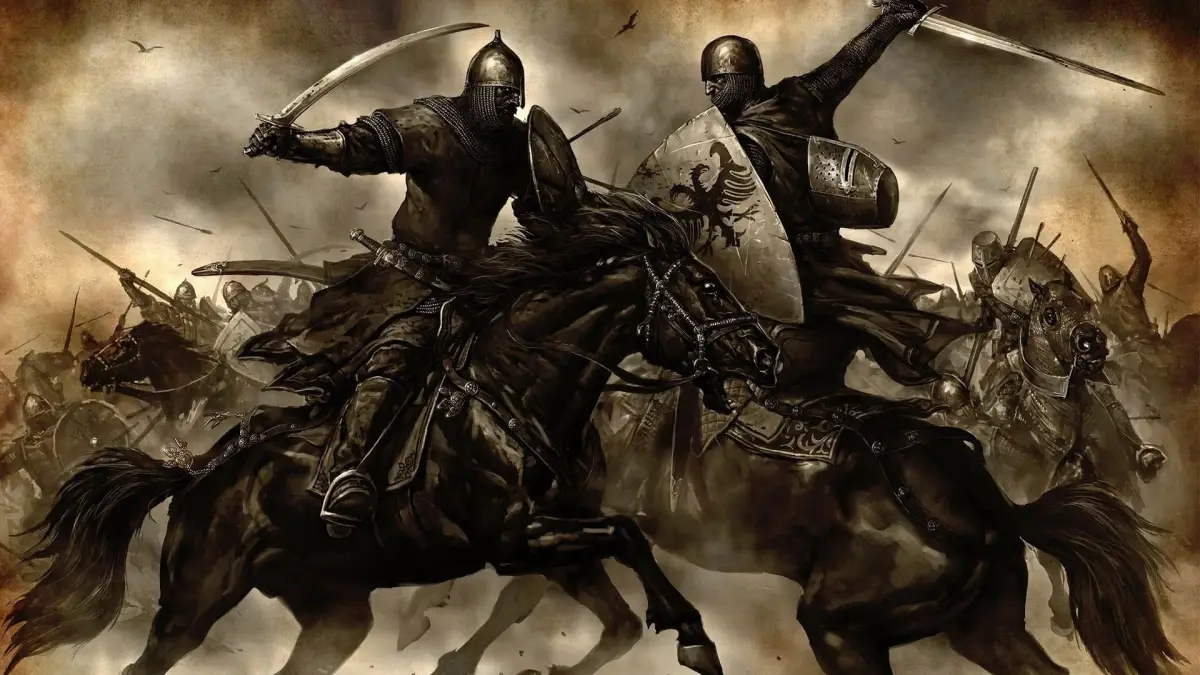
Welcome to Calradia, a land of warring kingdoms and endless opportunity. In Mount & Blade: Warband, you're dropped into a vast open world where you'll forge your own path. Start as a humble adventurer, recruit soldiers, engage in thrilling third-person combat, and navigate complex diplomacy. Whether you dream of becoming a renowned warlord, a cunning merchant, or a feared bandit, Warband offers the sandbox freedom to make it happen.
This guide is your key to mastering the intricate systems of Warband. We'll break down how to build powerful factions, manage your economy, and survive the brutal battles that define Calradia. Get ready to conquer, trade, and rule.
Part 1
Your essential guide to Mount & Blade: Warband Part 1. Learn about characters, armies, combat, romance, items, factions, and essential gameplay advice to start your journey.
Hey there! So you're diving into Mount & Blade: Warband, huh? Awesome choice! This guide is here to walk you through the very beginning, covering all the nitty-gritty stuff you need to know before you really get your adventuring career rolling.
Think of this as your friendly nudge into the world of Calradia. We'll break down the core mechanics – who you are, how to build your army, the basics of combat, even a little bit about finding a spouse (yeah, it's that deep!). We'll also cover the gear you'll be using, the different factions you can join, and how to actually start forming your own kingdom if you're feeling ambitious.
This guide is structured to give you a solid foundation. We'll cover:
- Characters: From the basics of your own character to the NPCs and heroes you'll meet.
- Armies: How to recruit, train, and manage your fighting force.
- Combat: The controls and how battles actually play out.
- Romance: Yes, even finding a spouse has its benefits!
- Items: A look at weapons, armor, horses, and more.
- Factions: Understanding the different groups and how to get involved.
- Gameplay Advice: Tips on character builds, making money, and warfare strategy.
We're going to cover everything from the ground up, so don't worry if you're completely new to this. Let's get you set up for success in Calradia!
Part 2
Learn about the core mechanics of Mount & Blade: Warband, including character attributes, skills, proficiencies, and how they influence gameplay. Understand character progression and stat bonuses.
This section of the guide assumes you are familiar with the basic controls and interactions in Mount & Blade: Warband (MBW). If not, please complete the in-game tutorial.
Abbreviations used in this guide include MBW for Mount & Blade: Warband, PC for Player Character, and NPC for Non-Player Character. Specific terms may also be followed by parenthetical abbreviations (e.g., Strength (Str)).
Mount & Blade: Warband Mechanics (00003)
Characters (00004)
MBW Basics (00005)
Every character in MBW possesses attributes, skills, and proficiencies that determine their abilities. Hit Points (HP) are calculated as 35 + Strength + 2 * Iron Flesh skill. Characters with 0 HP are knocked out or killed; Lords, your PC, and heroes are always knocked out.
Characters gain experience and advance in levels. Each level provides an additional attribute point, skill point, and proficiency points.
A Google Documents spreadsheet containing stats for most recruitable soldiers and all heroes is available at: ccc?key=0AtswgbELO72adGF0R0JrWk91NmtFanFBVm9BZE5fVkE&hl=en&authkey=CKbzxaUB. This link may be broken into two lines due to formatting constraints.
Spreadsheet Reading Guide:
- Units are listed under their faction's bolded heading.
- Abbreviations include Str (Strength), Agi (Agility), Int (Intelligence), Cha (Charisma), I. Flesh (Iron Flesh), PS (Power Strike), PT (Power Throw), PD (Power Draw), WM (Weapon Master), Sh (Shield), Ath (Athletics), Rdg (Riding), HAr (Horse Archery), Loot (Looting), Trk (Tracking), Tac (Tactics), Wound (Wound Treatment), Surg (Surgery), Eng (Engineering).
- Number-letter prefixes like (3A) indicate the unit's position on the promotion tree, with numbers representing levels and letters representing branches.
- Vet. (Veteran), Tr. (Trained), HA (Horse Archer), and d (Denars) are also used.
Attributes, Skills, & Proficiencies (00006)
Attributes are a character's fundamental physical and mental capabilities: Strength (Str), Agility (Agi), Intelligence (Int), and Charisma (Cha). Each attribute governs a set of skills, limiting a skill's maximum level to one-third of its governing attribute for PCs and recruited heroes.
Skills are specialized task abilities, such as tracking or trading. Proficiencies relate to weapon usage: one-handed, two-handed, polearms, crossbows, bows, and throwing weapons.
Part 3
Learn how Strength, Agility, and Intelligence impact combat, army management, and more in Mount & Blade: Warband. Maximize your character's potential.
Strength
Strength governs the Iron Flesh, Power Strike, Power Throw, and Power Draw skills. Each point of Strength also grants one additional Hit Point. Strength directly governs the ability to use heavy armor, crossbows, and melee weapons, with specific Strength requirements listed for each item. Some lighter armor and weapons may not have a Strength requirement. As Strength governs Power Throw and Power Draw, it indirectly governs the use of throwing weapons and hand-drawn bows. Each of these items will explicitly state the Power Draw/Throw requirement. All bows require at least 1 Power Draw, but some throwing weapons have no requirement.
A character with high Strength can deal more damage, wear better armor, use better weapons, and will have more Hit Points. Investing in the Iron Flesh skill can further increase Hit Points. Decent Strength is vital, as you will likely be your army's most experienced and best-equipped soldier, and your army will automatically lose any battle in which you are knocked out.
The Power skills impact different weapon types: Power Strike for all melee weapons, Power Draw for bows, and Power Throw for thrown weapons. Crossbows do not have a corresponding Power skill due to their mechanical tension. It is difficult to specialize in more than one Power skill. Generously investing points into your primary weapon type's Power skill can provide tremendous damage bonuses, ranging from 80-140% depending on the weapon type.
Agility
Agility governs Weapon Master, Shield, Athletics, Riding, Horse Archery, and Looting. Each point of Agility grants five additional weapon proficiency points. A character with high Agility, particularly with investment in Weapon Master, can increase weapon proficiency ratings more easily. The Shield skill is highly beneficial for defense, improving a shield's coverage, speed, and durability. If you intend to ride a horse, you will want at least 12 Agility to use a Charger, the best horse for direct combat. The fastest horse, the Courser, requires only 2 Riding, but at least 4 Riding skill is useful for increased horseback movement speed.
Athletics skill is dependent on your playstyle. Even mounted characters will be on foot during sieges, where Athletics can reduce exposure to missile attacks, though skill points might be better spent elsewhere. If your character is primarily on foot, Athletics offers significant value. Weapon Master allows for more proficiency points to be allocated to weapons, but proficiencies can also be increased by using the weapon, making Weapon Master a potential waste of skill points. Horse Archery requires investment in its specific skill. Looting is somewhat useful but is best left to Hero characters rather than your personal character.
Intelligence
Intelligence governs Trainer, Tracking, Tactics, Pathfinding, Spotting, Wound Treatment, Surgery, First Aid, Engineering, Inventory Management, and Persuasion. Each point of Intelligence grants an extra skill point, which is fortunate as Intelligence governs many important skills.
Persuasion and Inventory Management are Leader skills, meaning the game only uses your skill for relevant checks. Trainer is very useful; a party with high Trainer skill results in soldiers rapidly advancing in rank, making the army more effective. Tracking is useful for quests and general warfare. Tactics influences a battle parameter called battle advantage, potentially impacting morale or skill at arms. Pathfinding increases your party's map speed, and a hero should focus heavily on maximizing it. Wound Treatment, Surgery, and First Aid are essential for keeping your army healthy. Designate one character to specialize in these three skills as the party doctor, with another as a backup. Each skill point in Engineering reduces siege engine build time (ladders by 1 hour per point, siege towers by 6 hours per point), decreasing the time enemy relief units have to arrive. Persuasion is most useful for recruiting lords. Inventory Management allows your party to carry more items, enabling more loot collection, stable food supplies, and increased earnings from battles and pillaging, with lesser benefits including carrying alternate equipment and more goods for sale. Intelligence governs too many vital skills for one or three characters to handle, so it is likely you will want most heroes in your party to have some Intelligence investment.
Part 4
Learn about Mount & Blade: Warband Charisma skills like Prisoner Management and Leadership, and discover NPC types like Kings and Claimants.
Skills Governed by Charisma:
- Prisoner Management: Allows you to take more prisoners per point (0 skill means no prisoners). Useful for quests and ransoming captured lords for 1,000 to 4,000 denars (Kings yield 6,500 to 10,000 denars). A minimum of 1 skill point is recommended.
- Leadership: Each point increases max party size by 5, boosts party morale (increasing map movement speed), and lowers troop wages. Essential for army building.
- Trade: Reduces the "trade penalty," allowing you to buy items for less and sell them for more. It is best to have a hero with high Trade skill manage this, rather than investing your own skill points.
Skill Types:
- Personal Skills: Related to individual characters; each must raise their own to benefit.
- Party Skills: Use the highest value held by any conscious (less than 33% HP) hero or the PC (player character), regardless of HP. The PC's skill in a party skill provides a bonus if the PC has ranks in it. A single skill point provides a +1 bonus, which is the only level at which this feature is remotely useful.
NPC Types:
- Kings: Lead factions.
- Claimants: Wish to lead a faction. Find them by speaking with the 'Traveler' NPC in a tavern. You can offer assistance if your renown is at least 250 (though more is recommended). Becoming a claimant's champion makes you part of their pseudo-faction and requires defeating the faction they wish to control. If you take your current faction's claimant's quest, you keep your owned cities, castles, and villages.
- Ladies: Sisters, daughters, mothers, or wives to lords. Positive relations can allow you to use them to influence lords, though this is expensive. Male PCs can dedicate tournament victories or discuss poetry with them to improve relations for marriage.
- Lords: Directly manage parts of a kingdom. Strong relations result in more and more important quests and openness to romance with a female PC.
- Towns: Perform many functions. Stronger relations may impact goods prices. Improving relations is mainly done by completing quests for the town's guildmaster. Spending 1000 denars on drinks for the town gives a mere +1 relation. Collecting full taxes hurts relations.
- Villages: Provide recruits and sell supplies. Improving relations by completing quests for their elder increases recruit availability. Village quests pay poorly.
Finding Locations and NPCs:
- To locate any town or village, go to the Notes tab, then Locations, select the location, and click 'Show On Map'.
- To find an NPC's last known location, go to Characters. This location can be updated by speaking to other lords or ladies in their faction.
- Charisma also increases your maximum party size by one per point.
- Leadership increases party morale, which boosts map movement speed.
- It is a waste of skill points to increase your own Trade skill; rely on heroes instead.
- A single skill point in a party skill provides a +1 bonus, but it's generally best to ignore this feature.
- Stronger relations with lords and kings lead to better quests and potential romance.
- Helping a lord with a quest is more effective for improving relations than using ladies to influence them.
- You will want much more renown than the minimum 250 to begin a claimant's quest.
- Villages provide recruits, but you won't need too many, and even those at 0 relation will still provide a decent stream.
Similar guides you might like

100% Human-Written. AI Fact-Checked. Community Verified. Learn how AntMag verifies content