
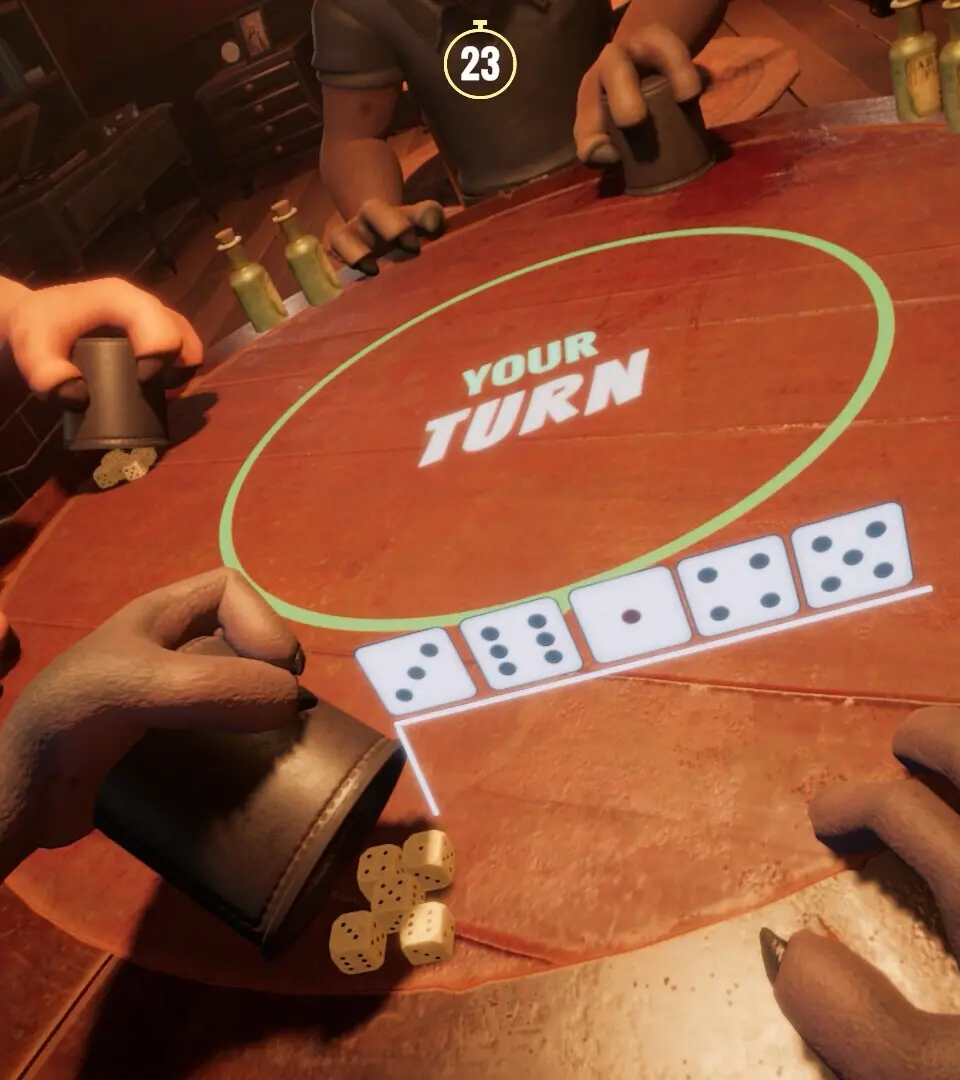
Learn the power of the "Spot On" call in Liar's Bar's Liar's Dice minigame. Master probability and deduction to successfully confirm your bids and win.
Liar's Dice, the central minigame within Liar's Bar, is a thrilling blend of probability, deduction, and outright deception. While the core mechanics are familiar to fans of the classic dice game, Liar's Bar introduces specific nuances, most notably the highly impactful "Spot On" call. Understanding this mechanic, and how to confirm its presence and function, is paramount to mastering the game and securing victory against your opponents.
Understanding and Executing the "Spot On" Call in Liar's Bar
The "Spot On" call is a strategic maneuver in Liar's Dice that allows a player to declare the *exact* total count of a specific die face value across all players' cups. Unlike a standard bid, which increases the stakes, or a "Liar!" challenge, which disputes a bid, a "Spot On" call is a declaration of absolute certainty about the current dice distribution. Mastering this mechanic is crucial for advanced play in Liar's Bar.
Confirming the "Spot On" Call's Availability
In Liar's Bar, the "Spot On" call is not always an active option in every game. Its availability is determined by the specific ruleset chosen for the match, often influenced by the host or the game's default settings. There isn't a persistent UI element that announces "Spot On is active." Instead, its presence is confirmed dynamically during gameplay:
- UI Indicator: After an opponent makes a bid (e.g., "four 3s"), and before the next player can bid or challenge, the interface will present available actions. If the "Spot On" call is enabled for the current game, you will see a distinct button or prompt specifically labeled "Spot On" alongside the standard "Liar!" challenge button. This prompt will typically be visually distinct, perhaps using a different color or icon to signify its unique nature.
- Absence of Prompt: If, after a bid, you only see the option to make a new bid or issue a "Liar!" challenge, then the "Spot On" call is not active for that particular game session.
- Observational Confirmation: For players new to Liar's Bar, observing experienced players or checking community forums and guides can provide further confirmation of whether the "Spot On" mechanic is a standard feature or a selectable variant.
Mechanics of the "Spot On" Call
The "Spot On" call operates on a principle of precise numerical accuracy. It's a high-stakes gamble that, if successful, can end a round decisively in your favor.
- Initiating the "Spot On" Call:
- Wait for an opponent to make a bid. For example, Player A bids "five 6s."
- Carefully assess the dice you can see in your own cup and consider the probabilities based on the number of dice remaining for all players.
- If you are absolutely certain that the total number of 6s across *all* players' cups is exactly five, you can then select the "Spot On" prompt.
- Outcome of a Correct "Spot On" Call:
- Scenario: Player A bids "five 6s." You, Player B, believe there are precisely five 6s in total. You call "Spot On."
- Verification: All players reveal their dice. If the count of 6s is indeed exactly five, your "Spot On" call is correct.
- Result: You win the round immediately. All other players lose one die. This is the most advantageous outcome, as it can significantly reduce your opponents' dice count and bring you closer to victory.
- Outcome of an Incorrect "Spot On" Call:
- Scenario: Player A bids "five 6s." You, Player B, believe there are precisely five 6s. You call "Spot On."
- Verification: All players reveal their dice. If the count of 6s is *not* exactly five (e.g., there are four 6s, or six 6s), your "Spot On" call is incorrect.
- Result: You suffer a severe penalty: you lose one of your own dice. The round does not end; play typically continues with the previous bid ("five 6s") still in effect, and the turn passes to the next player. This penalty makes the "Spot On" call a risky proposition.
Deep Dive into Bidding and Challenging: The Foundation of Liar's Dice
The "Spot On" call is an advanced layer built upon the fundamental mechanics of bidding and challenging. A thorough understanding of these core elements is essential before attempting to master the "Spot On" mechanic.
The Nuances of a Bid
A bid in Liar's Dice is a statement about the minimum quantity of a specific die face value that the bidder believes exists across all players' cups. The key is that the actual count must be *equal to or greater than* the bid.
- Bid Structure: A bid consists of two parts: a quantity and a die face value. For example, "three 4s."
- Truth of a Bid:
- If Player A bids "six 2s," and the total number of 2s revealed across all dice is exactly six, the bid is true.
- If the total number of 2s is seven, eight, or more, the bid is also considered true.
- Only if the total number of 2s is five or fewer is the bid false.
- Progression of Bids: Subsequent bids must either increase the quantity of the same die face value or increase the die face value while keeping the quantity the same or higher. For example, if the current bid is "six 2s," the next bid could be "seven 2s," or "one 3" (if using a specific rule variant that allows resetting the count with a higher face value), or "six 3s." The exact rules for bid progression can vary, but generally, you must bid "more" in some defined way.
The "Liar!" Challenge: Calling Out Deception
The "Liar!" challenge is the primary mechanism for disputing a bid that you believe is false. It's a direct accusation of bluffing.
- When to Challenge: You issue a "Liar!" challenge when you believe the previous bid's stated quantity is *higher* than the actual total count of that die face value across all dice.
- Steps to Issue a "Liar!" Challenge:
- Listen intently to the bid made by You immediately preceding you.
- Analyze your own dice and consider the number of dice held by each opponent.
- Formulate a judgment: Do you believe the stated quantity is achievable, or is it an overstatement?
- If you believe the bid is false, select the "Liar!" prompt before the next player has a chance to make a bid or issue their own challenge.
- Consequences of a "Liar!" Challenge:
- If the Bid is Proven False: You who made the false bid loses one of their dice. You who successfully challenged the bid typically retains their dice, and the turn passes to You to their left to make a new bid.
- If the Bid is Proven True: You who incorrectly issued the "Liar!" challenge loses one of their own dice. You who made the bid successfully retains their dice, and the turn continues as normal.
Advanced Strategies and "Spot On" Tactics in Liar's Bar
Mastering Liar's Dice in Liar's Bar involves more than just understanding the rules; it requires strategic thinking, keen observation, and calculated risk-taking. The "Spot On" call introduces a unique dimension to these strategies.
- Dice Management is Paramount:
- Always keep track of how many dice you and your opponents possess. Losing dice is the primary way to be eliminated from the game.
- Opponents with fewer dice are often under pressure and may be forced into making riskier bids or "Spot On" calls.
- Conversely, having more dice gives you more options and makes you less vulnerable to early elimination.
- Reading Your Opponents:
- Observe bidding patterns. Does a player consistently bid high? Do they hesitate before making a bid? These can be subtle tells.
- Pay attention to their reactions after a bid or challenge. Do they seem relieved or frustrated?
- The "Spot On" call is particularly effective against players who are overly confident in their dice count or who tend to make very specific, precise bids that might be tempting to call "Spot On."
- Strategic Use of the "Spot On" Call:
- The Calculated Gamble: The "Spot On" call should not be used lightly due to the severe penalty for an incorrect guess. It is best employed when you have a very high degree of certainty about the exact dice count. This often occurs when opponents have few dice remaining, making the total count more predictable.
- Bluffing with "Spot On": While risky, a "Spot On" call can sometimes be used as a bluff. If you have a strong suspicion that the count is *close* to the bid, and you want to force a decisive outcome or punish an opponent who you believe is bluffing, a "Spot On" call might be considered. However, the risk of losing a die makes this a desperate measure.
- Targeting Specific Opponents: If you notice an opponent is particularly proud of their dice count or tends to be very precise, you might use the "Spot On" call to challenge their perceived certainty.
- When to Issue a "Liar!" Challenge:
- Focus on High-Risk Bids: Challenges are most effective when the bid is high, and the opponent has few dice. If they are wrong, they lose a die and might be eliminated.
- Consider Your Own Risk: Before challenging, ask yourself: "If I'm wrong, can I afford to lose a die?" If losing a die would put you in a precarious position, it might be wiser to let the bid pass.
- The "Spot On" Counter-Play: If an opponent makes a "Spot On" call, you cannot challenge it directly. Your only recourse is to hope their call is incorrect and they lose their die. If they are correct, you lose a die.
- Opening Bids and Traps:
- The first bid often sets the tone. A conservative bid like "two 1s" is common if a player has two 1s.
- However, experienced players might use the opening bid to set a trap, making a slightly higher bid to test the waters or force an early challenge.
- Be wary of seemingly innocuous opening bids that might be designed to lull you into a false sense of security before a more aggressive bidding war begins.
- The "Spot On" vs. "Liar!" Dynamic:
- A "Spot On" call is a declaration of *exact* certainty.
- A "Liar!" challenge is a dispute of a bid being *at least* a certain amount.
- These two mechanics are distinct and serve different strategic purposes. A "Spot On" call is a proactive move to win the round decisively, while a "Liar!" challenge is a reactive move to punish a perceived bluff.
By internalizing the mechanics of the "Spot On" call, understanding the foundational principles of bidding and challenging, and applying these advanced strategies, You can transform their Liar's Dice gameplay in Liar's Bar from a game of chance into a sophisticated battle of wits, observation, and calculated deception.
100% Human-Written. AI Fact-Checked. Community Verified. Learn how AntMag verifies content