
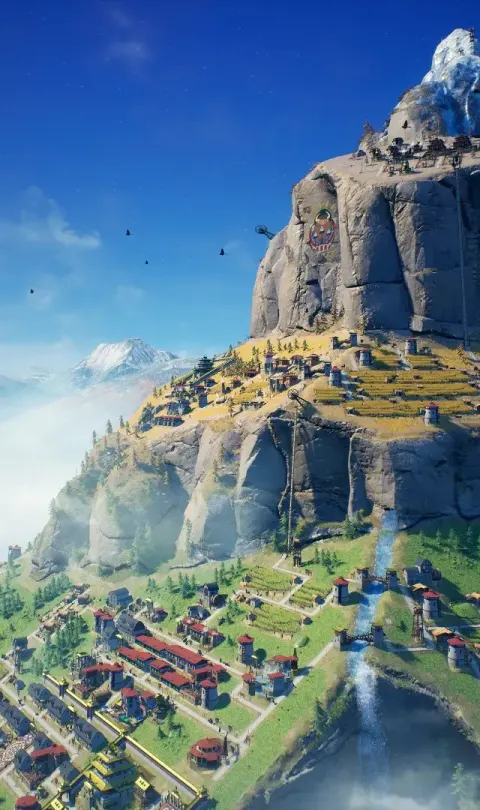
Expand your Laysara: Summit Kingdom settlement efficiently during the mid game. Transition to new resource chains and unlock advanced production buildings.
As your settlement in Laysara: Summit Kingdom grows, the initial fertile zones will likely become insufficient to support your expanding population and resource demands. This is the critical juncture where mid-game expansion becomes paramount. You'll need to strategically adjust your build strategy to accommodate the varying vegetation zones present on the mountain slopes. These zones dictate what resources are readily available and what challenges you'll face. Expanding to more distant mountain slopes is not just about acquiring more space; it's about reaching scarce resources that are vital for your continued growth and prosperity. This often involves overcoming environmental obstacles and carefully planning your infrastructure to connect these new outposts to your main settlement. The success of your mid-game hinges on your ability to adapt your building priorities and resource management to these new, often harsher, environments. Consider the long-term implications of your expansion, such as the increased demand on your supply chains and the potential for new threats or opportunities that arise from venturing further afield.
The decision to expand should be driven by specific resource needs. For instance, if your current supply of wood is dwindling, you'll need to identify and secure new forested areas, even if they are located on less accessible slopes. Similarly, if you require specific minerals for advanced crafting or construction, you must scout for deposits on higher or more remote parts of the mountain. This proactive approach to resource acquisition is key to avoiding mid-game stagnation. It's also important to consider the terrain itself. Building on steeper slopes can present unique challenges in terms of stability and accessibility, requiring specialized construction techniques or infrastructure. The game's mechanics encourage a dynamic approach, where your settlement's layout and focus must evolve alongside the challenges and opportunities presented by the mountainous landscape. This phase of the game is about pushing your boundaries, both geographically and strategically, to ensure the long-term viability of your Kingdom.
Navigating Vegetation Zones
Laysara: Summit Kingdom features distinct vegetation zones, each with its own set of benefits and drawbacks. Lower altitudes might offer more abundant flora for early-game needs, but as you ascend, you'll encounter zones that are more challenging to build in but potentially richer in rare resources. Understanding these zones is crucial for effective expansion. For example, a zone known for its dense forests might be ideal for lumber production, while a rocky, sparse area higher up could hold valuable mineral deposits. Your build strategy must adapt to these environmental realities. This means not just placing buildings, but considering how they interact with the surrounding terrain and vegetation. A well-placed quarry near a mineral-rich vein on a steep slope, for instance, can significantly boost your production, but it will require robust infrastructure to transport the mined goods back to your workshops. Conversely, attempting to cultivate crops in an unsuitable zone will lead to inefficiency and potential failure, highlighting the importance of matching your needs to the environment.
Reaching Scarce Resources
The core of mid-game expansion revolves around accessing resources that are not readily available in your starting area. These scarce resources are often located on more distant mountain slopes, requiring you to invest in new infrastructure and potentially establish satellite outposts. This might involve building new roads, bridges, or even tunnels to connect these resource-rich areas to your main settlement. The further you expand, the more complex your logistics become. You'll need to ensure a steady flow of goods and workers between your various locations. This could involve optimizing your transportation networks, establishing dedicated trade routes, or even developing specialized production chains in different areas to minimize travel time and maximize efficiency. The game rewards foresight and careful planning in these expansion efforts, as neglecting the logistical challenges can quickly lead to bottlenecks and hinder your overall progress. Successfully tapping into these distant resources is what allows your Kingdom to thrive beyond its initial limitations.
100% Human-Written. AI Fact-Checked. Community Verified. Learn how AntMag verifies content