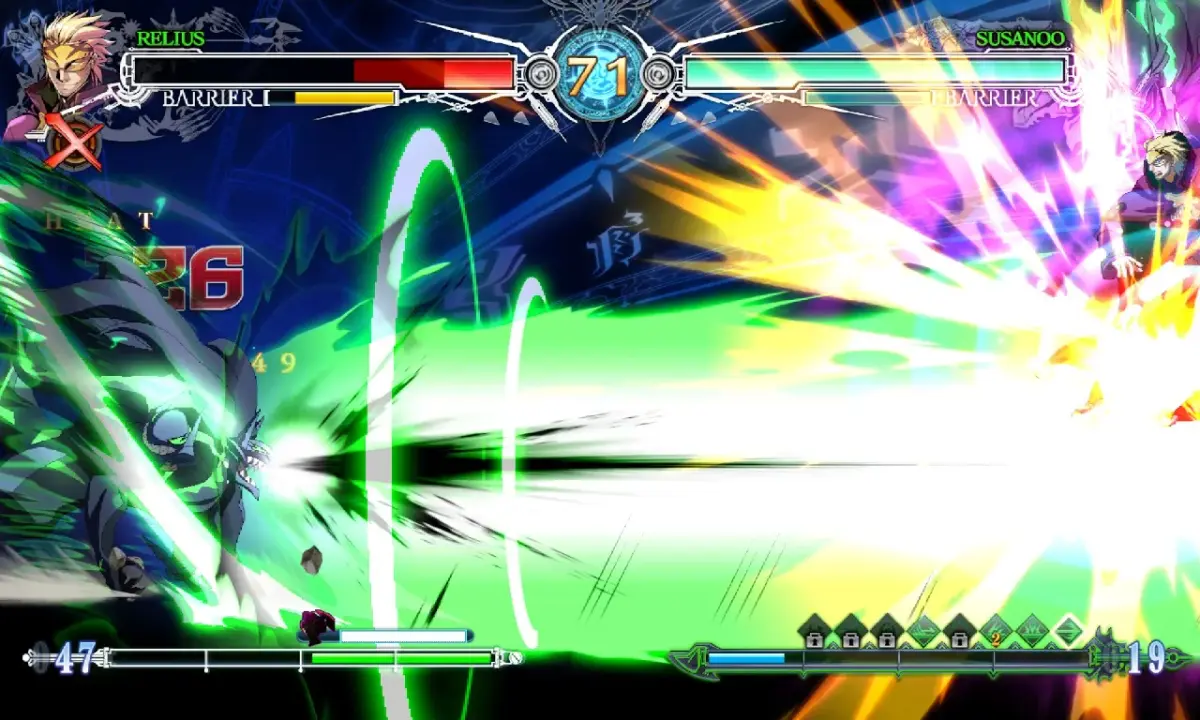
Learn how to master neutral in BlazBlue: Central Fiction by understanding priority, spacing tools, and when to approach, maintain distance, or retreat.
To understand BlazBlue: Central Fiction's neutral game, you must first grasp the concept of priority. At any given distance, the player whose approach (movement + attack) reaches the opponent faster wins. Ideally, this approach should be reasonably safe, achieved through a character's spacing tool or poke. Your goal in neutral is to establish a distance where your approach has priority, allowing you to dictate the pace. From this advantageous range, you can choose to attack, maintain the distance to threaten an attack, or retreat if you need time (e.g., to recover Drive Gauge) or wish to play passively.
If you know your opponent will block, you can sometimes 'skip the neutral-to-offense-transition' by dashing past your poke's range. This allows access to fast mixups, typically from close range, to break the enemy's guard quickly. This is an abuse of priority and is risky, as you are vulnerable while dashing. It can lead to losing your pressure opportunity if the opponent jumps back to neutral, or even a heavy punish if they predict your dash and attack. Use this tactic sparingly.
Many characters have an 'illegal/abusive approach tool' that forces priority. These are typically unsafe attacks on whiff or block that allow you to quickly cover more distance than your spacing tool and catch the opponent off guard. Examples include sweeps or specials like Ragna's Hell's Fang (214A), Mai's Himeyuri (236A), or Tsubaki's sweep (3C). The degree of unsafety depends on the opponent's character, distance, and your cancelling options; even 50% meter won't help if you can't Rapid Cancel a whiffed attack.
To counter these approaches, recognize when and at what distance the opponent tends to use them (e.g., after you jump or they use a projectile). Find the weakness, which might simply be blocking. For instance, Mai's Himeyuri (236A) has a long recovery. You can make it whiff by jumping when you predict its use based on distance. Any descending air attack can then punish her whiffed 236A.
The character with priority in most distances generally wins neutral. Taokaka (due to speed) and Izanami (due to instant long-range projectiles) are examples. The player with priority can choose to approach, while the opponent must react to the enemy's options. The opponent can try to evade/re-position if they have space to do so safely, or stand their ground to guard or counter. Standing ground involves reacting or predicting the enemy's approach, potentially using anti-airs or even risky Drive Pershaals (DPs) in neutral.
Countering usually takes longer than evading, and reacting takes time compared to predicting. To counter, you might need to predict. To evade, you might have time to react, which is safer but less rewarding than predicting and countering.
Your character type significantly impacts decisions. Faster characters like Naoto may counter on reaction (after seeing the approach), while slower characters like Hakumen or Kagura might need to predict and commit to an action to counter. Your playstyle (passive/aggressive, offensive/defensive, approaching/evading) should adapt to your character and your opponent's. Generally, speed and range vary inversely: faster attacks have shorter reaches, while slower attacks have longer reaches. Characters with faster, shorter-range tools excel up close ('Rushdown' characters like Makoto), while characters with slower, longer-range tools win neutral from afar ('Zoner' characters like v-13).
100% Human-Written. AI Fact-Checked. Community Verified. Learn how AntMag verifies content