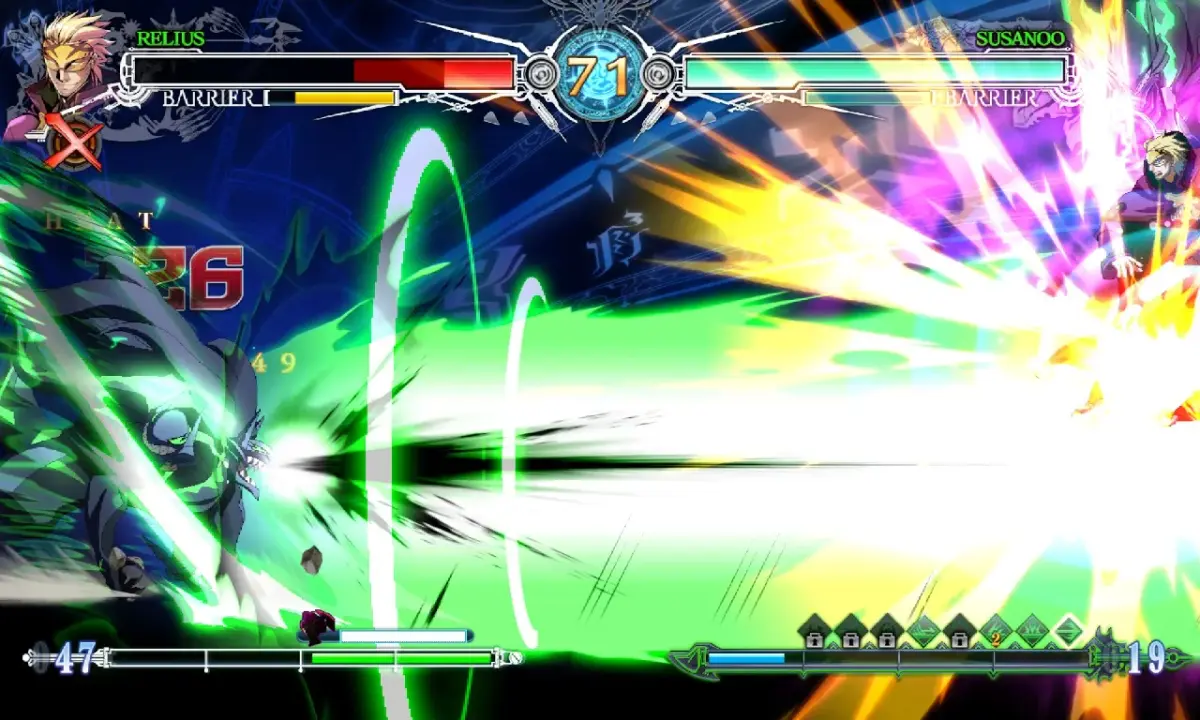
Master BlazBlue: Central Fiction pressure by studying attack properties, building tight strings, and practicing mix-ups and punishment options after each move.
To effectively apply BlazBlue: Central Fiction's theoretical combat concepts in real battles, focus on thinking about your options after every attack rather than auto-piloting. This involves understanding your character's moveset, constructing tight blockstrings, and knowing how to transition into mix-ups or continue pressure.
Study Attack Properties:
Categorize your attacks based on their utility for pressure strategies. This includes identifying:
- Mixups: Which attacks can be used to open up the opponent and when.
- Resets: Opportunities to restart pressure sequences.
- Low Attacks: Examples for Jin include 2B, 3C, and 214B/D.
- Overheads: Examples for Jin include 6A and tk.214D.
- Jump Cancellable Attacks: Moves that allow for aerial follow-ups (e.g., Jin's 2A, 5A, 5C, 2C, j.B, j.2C).
- Plus on Block Moves: Attacks that leave you at an advantage after the opponent blocks (e.g., Jin's 6D).
- Frametraps: Blockstrings with small gaps that can catch opponents trying to retaliate (e.g., Jin's 5C into 2C, 2C after 5B, or delay cancels like 2A ~ 2A).
- Meter Usage for Extension: Using 25% meter for 236D or 50% meter for Rapid Cancel to extend pressure after certain normals (like Jin's 6B or 3C).
Build Tight Blockstrings:
A tight or gapless string ensures the opponent cannot act between your attacks. You can test this by having the dummy block only the first hit; if they block the entire string, it's tight. Frame-data wise, a string is tight if the blockstun of the first hit equals or exceeds the startup of the second hit. An example of a tight string for Jin is 2A, 5B, 2B, 5C, 3C, 236A.
Develop Options After Each Attack:
After each move in your string, consider various follow-up options:
- Mixups: Transition into overheads, grabs, command grabs (like Jin's Hizangeki - 2147D), or special moves (like Crush Trigger).
- Repeat Normals: Re-using short-recovery normals (like 2A) can keep the opponent guessing about when you'll commit to a mix-up.
- Punish Whiffs/Specific Reactions: Use moves like Jin's 5A (which typically hits standing opponents) to punish specific defensive options like Throw Tech Option Selects or to set up situations where it hits crouching opponents. Use moves like 2B to punish opponents who attempt a Dragon Punch (DP) after blocking your attack.
- Stagger/Gap Pressure: Dash to re-approach or intentionally leave a gap to bait and punish fuzzy blocks or fuzzy jumps.
- Jump Cancels: After a jump cancellable move, you can perform aerial attacks, cross-ups, or feint crossings-over. You can also use late air dashes or empty jumps for high/low mixups.
Strategic Decision Making During Pressure:
Decide whether to go for a Mixup (effective against passive blocking) or Continue the String (useful if the opponent is defending against mixups). Avoid overusing punishment pressure, as it can end your offense if blocked. Balance mixups with punishment pressure, using tactics like staggered dashes to create unpredictable offense.
Concluding Strategy:
Create a pressure strategy with a specific goal for your next encounter. For example, aim to punish a specific anti-air response with a well-timed sequence like Jin's 5C into a jump cancel and vertical double jump to counter a whiffed anti-air with a landing j.2C. Always adapt your goals throughout the match based on the opponent's actions, varying your strategies within the same string to keep them guessing.
100% Human-Written. AI Fact-Checked. Community Verified. Learn how AntMag verifies content